
Table of Contents
- What STC rating do hotel guest room doors need for quiet sleep?
- Why corridor noise is a hotel’s top guest complaint
- What does STC actually measure?
- Acoustic benchmarks by hotel property segment
- STC is a system rating — not a door leaf specification
- STC 30 to STC 42 — tested as a complete system
- Acoustic door specification checklist for hotel projects
- Frequently asked questions
- Specify with confidence. We back it with test data.
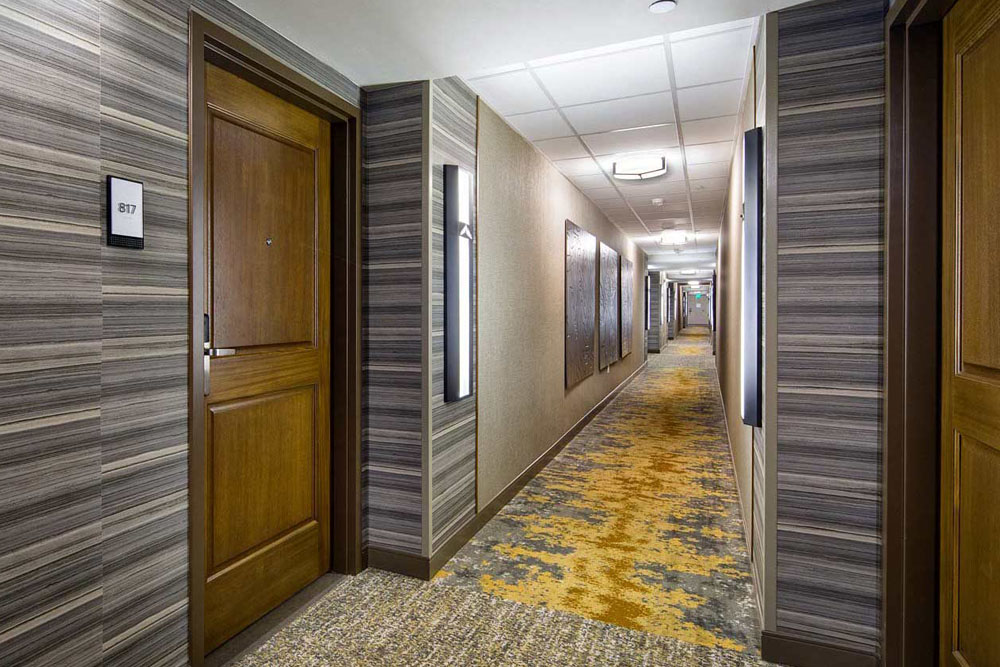
What STC rating do hotel guest room doors need for quiet sleep?
Standard hotel guest room doors should achieve at least STC 35 in laboratory testing; premium suites and luxury properties typically specify STC 40 or higher. In real-world field conditions, the accepted minimum is FSTC 30. Hilton’s dual acceptance standard — which Forest Bright is certified to meet as Hilton’s approved supplier — requires lab STC ≥ 35 and field FSTC ≥ 30. Forest Bright’s acoustic door systems cover the full range from STC 30 to STC 42, each tested by Intertek to ASTM E90 + E413.
Why corridor noise is a hotel’s top guest complaint
A $250-per-night room earns one-star reviews because of a thin door. Footsteps, housekeeping carts, elevator mechanics, and neighboring room conversations all travel through the corridor — and the door is the weakest acoustic point in the wall assembly.
Unlike the concrete or gypsum walls around it, the door is an operable assembly with joints, perimeter gaps, and a floor gap that each degrade sound insulation if not engineered correctly. For architects, specifiers, and hotel operators sourcing doors for the U.S. commercial market, STC is the key acoustic specification — but only meaningful when the entire door system is tested as a single assembly.
What does STC actually measure?
STC — Sound Transmission Class — is a single-number rating that quantifies how effectively a building element blocks airborne sound across a range of frequencies. It is measured in a controlled laboratory environment per ASTM E90 + E413. A higher number means better acoustic separation.
STC vs. FSTC — the gap that matters on site
STC (Laboratory)
Measured in a controlled test chamber under ideal conditions. The result reflects the door assembly’s maximum acoustic potential with no installation variables.
FSTC (Field)
Measured after installation in the actual building. Flanking paths — gaps at the floor, frame joints, and perimeter — reduce real-world performance. Field STC is typically 3–5 points lower than lab STC.
Specifying only lab STC without requiring field verification is one of the most common sources of post-occupancy acoustic complaints in hotel construction and renovation.
Acoustic benchmarks by hotel property segment
The following benchmarks reflect typical acoustic performance targets applied by hotel brands, operators, and specification consultants across the U.S. market.
| Property Segment | Typical Examples | Lab STC Target | Field FSTC Target |
|---|---|---|---|
| Economy / Limited Service | Budget hotels, motels | STC 30–33 | FSTC 27–30 |
| Full Service / Select Service | Hilton Garden Inn, Marriott | STC 35 (minimum) | FSTC 30 (minimum) |
| Upscale / Upper Upscale | Hilton, Marriott Marquis, CitizenM | STC 38–40 | FSTC 33–36 |
| Luxury / Ultra-Luxury | Premium suites, boutique luxury | STC 42+ | FSTC 38+ |
These are general U.S. market benchmarks. Specific hotel brand standards may vary. Consult the brand’s technical standards document for your project.
Hilton Certification — Forest Bright
As Hilton’s certified wood door supplier for China operations, Forest Bright meets Hilton’s dual acoustic acceptance standard: laboratory STC ≥ 35 and field FSTC ≥ 30. This benchmark is embedded into every hotel door system we manufacture and ship — from the core material selection through to factory pre-installed hardware and perimeter sealing.
STC is a system rating — not a door leaf specification
The most common specification error in hotel door procurement is treating STC as a property of the door panel alone. In practice, STC performance is determined by the complete door assembly. A high-STC door leaf installed with an undersized automatic door bottom or a poorly fitted frame will not deliver the rated performance — and the gap shows up in FSTC measurements after occupancy.
Four components that determine acoustic performance
The door leaf’s core is the primary mass barrier. Forest Bright’s acoustic composite core is engineered specifically for sound damping — distinct from the solid particleboard used in standard commercial doors.
A double-rebate (dual-stop) frame creates two engagement points between door leaf and frame — significantly reducing the flanking paths that cause field performance to drop below lab ratings.
Continuous compression seals at the head and jambs close the air gap between door leaf and frame. Without quality seals, even the densest core cannot prevent flanking transmission at the perimeter.
The floor gap beneath the door is typically the single largest acoustic failure point. An automatic door bottom drops to seal the gap when the door closes and retracts cleanly on opening for smooth daily operation.
Forest Bright · Acoustic Door Systems
STC 30 to STC 42 — tested as a complete system
Forest Bright’s hotel acoustic door range covers STC 30 to STC 42 — tested per ASTM E90 + E413 by Intertek, an internationally recognized third-party laboratory. Every system — door leaf, frame, perimeter seals, automatic door bottom, and hardware — is specified, manufactured, and tested together as a complete assembly. Lab performance carries through to the field because the system is engineered for it from the start.
Acoustic door specification checklist for hotel projects
Whether you are writing a new-build door specification or sourcing for a hotel renovation, the checklist below covers the acoustic performance requirements that protect the project from post-occupancy noise complaints.
Lab STC minimum: specify STC 35 for standard guest rooms; STC 40 for suites and luxury properties.
Test standard: require ASTM E90 + E413 test reports from a recognized third-party laboratory such as Intertek.
Complete system rating: confirm the STC rating applies to the full assembly — door leaf, frame, perimeter seals, and automatic door bottom — not the panel in isolation.
Double-rebate frame: specify dual-stop rebate construction for STC 38 and above — single-rebate frames cannot reliably close the perimeter path at high performance levels.
Automatic door bottom: require an automatic drop-seal door bottom — surface-applied thresholds are not an acoustic equivalent.
Endurance rating: specify WDMA TM-7 testing at 1,000,000 cycles, Extra Heavy Duty under ANSI/WDMA I.S. 1A-13 — hotel doors cycle thousands of times per year and must maintain acoustic performance long-term.
Field verification: include post-installation FSTC testing for a representative sample of rooms, with a minimum accepted result of FSTC 30.
Frequently asked questions
Does a higher STC door leaf guarantee a quiet hotel room?
No. STC performance depends on the complete system — door leaf, frame, perimeter seals, automatic door bottom, and hardware. A high-STC panel installed with an improper door bottom or poor frame fit will underperform significantly. Forest Bright tests and delivers acoustic systems as complete assemblies — that is why field FSTC holds close to lab STC on Forest Bright installations.
Can an acoustic hotel door also be fire-rated?
Yes. Forest Bright acoustic doors can integrate fire-rated performance within the same assembly. Fire rating is achieved through UL 10C certified construction covering 30, 60, 90, and 120-minute ratings. Combined acoustic and fire performance in a single door is a common requirement for hotel corridor applications under U.S. building codes.
How long will a hotel acoustic wood door maintain its performance?
Forest Bright doors are tested to 1,000,000 cycles under WDMA TM-7 — achieving Extra Heavy Duty, the highest tier under ANSI/WDMA I.S. 1A-13. That validates structural and acoustic integrity through decades of hotel operation. Factory pre-installed hardware maintains precision over extended daily use.
What is factory pre-fabrication and why does it matter for hotel renovations?
Factory pre-fabrication means hardware mortises, lock plates, hinge cutouts, and door closer bases are all machined at the factory before shipment. On-site work is reduced to assembly and final adjustment. For hotel renovations — where every closed day represents lost room revenue — this significantly shortens installation time and reduces the acoustic risk that comes from on-site fabrication inconsistencies.
What natural veneer options are available for hotel acoustic doors?
Forest Bright acoustic doors are available with natural wood veneer surfaces including oak, walnut, cherry, maple, and teak — as well as engineered veneer, stained veneer, and catalyzed polyurethane finishes in any color. The acoustic system is independent of the surface finish, so there is no visual trade-off for acoustic performance.
Forest Bright · Hotel Acoustic Door Systems
Specify with confidence. We back it with test data.
Forest Bright provides full Intertek test reports, complete acoustic system specifications, and project support for architects, specifiers, and hotel operators in the U.S. market.
