
Engineered for Purpose
Acoustic Door System
Door, frame, and seals — engineered as one tested assembly. Sound ratings belong to the assembly, not the leaf: we configure and supply the complete system the rating was tested on.
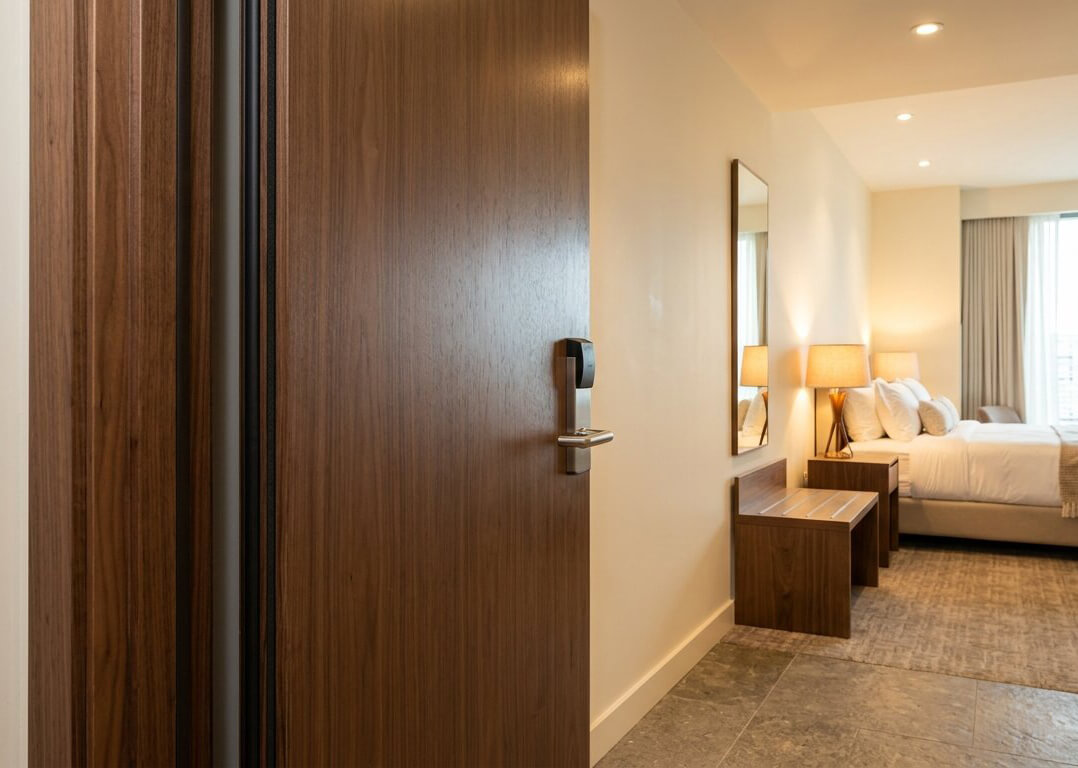
Why Acoustic Doors
The door is the weakest link in sound isolation
In any acoustic design, the door is usually the weakest element in the wall — and the one that decides whether the room performs. Sound isolation is not a comfort feature: in hotels, healthcare, education, and offices, it is written into brand standards and project specifications.
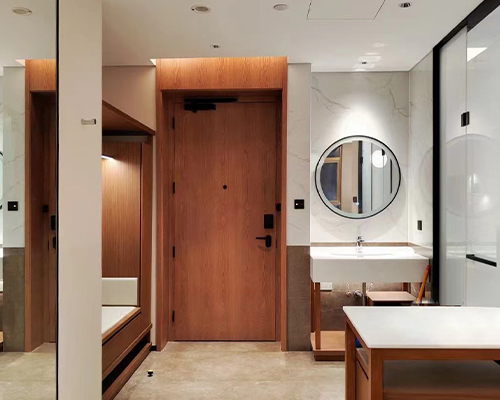
Hospitality
Guest satisfaction starts with a quiet night's sleep.
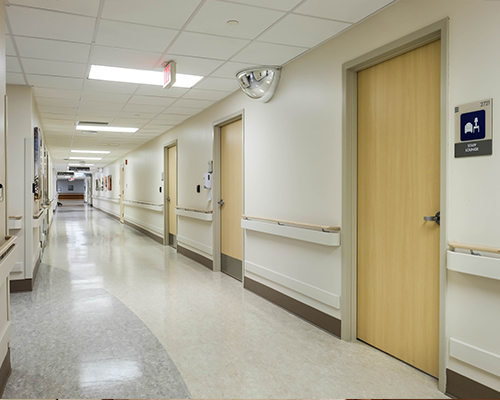
Healthcare
Quiet environments support recovery and protect patient privacy.
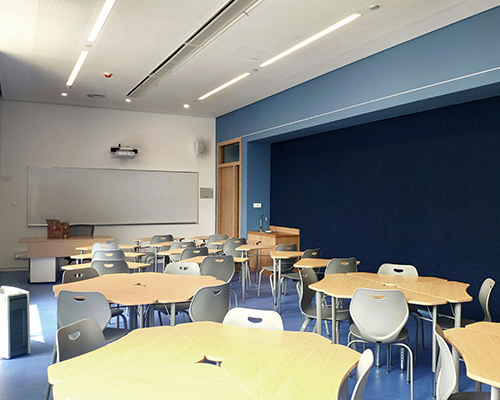
Education
A quieter classroom means better focus and learning.
How loud is loud
Sound levels around us, and the targets projects specify
Corridor conversation sits around 60–70 dB. A guestroom at night should sit near 30 dB. The door assembly is what carries most of that difference — which is why specifications name a number, not a material.
| Environment / Sound Source | Sound Level (dB) | |
|---|---|---|
| Jet engine at close range | 140 |  |
| Car horn nearby | 110 | |
| Inside a subway train | 90 | |
| Inside a bus | 80 |  |
| Urban traffic | 70 | |
| Normal conversation | 60 | |
| Standard office | 50 |  |
| Living room / background music | 40 | |
| Quiet bedroom at night | 30 | |
| Broadcast studio | 20 |  |
| Threshold of human hearing | 0 |
What gets specified
Typical acoustic targets in North American projects
Forest Bright ships tested assemblies from STC 32 to STC 42 — every rating a third-party laboratory result for the full operable assembly.
Note: targets vary by brand standard and project specification. Common reference frameworks include hotel brand design standards, ANSI/ASA S12.60 (classroom acoustics), and the FGI Guidelines (healthcare). Values shown are typical specification ranges, not code minimums. Field-measured results (FSTC) typically run 5–7 dB below laboratory values due to flanking paths and installation variables.
Understanding STC
One number, measured on the whole assembly
STC (Sound Transmission Class) is the North American single-number rating for airborne sound isolation, tested to ASTM E90 and rated to ASTM E413. It weights the speech frequency range (125–4,000 Hz) — voices, television, music.
What STC sounds like
| Rating | What you hear on the other side |
|---|---|
| STC 25 | Normal speech clearly understood |
| STC 30 | Normal speech audible; loud speech understood |
| STC 35 | Loud speech audible but mostly unintelligible |
| STC 40 | Loud speech heard only faintly |
| STC 45 | Loud speech barely audible |
| STC 50 | Only very loud sounds — shouting, music bass — faintly heard |
How acoustic doors are tested
01
Source room
Sound is played through a calibrated speaker in the source room.
02
Receiving room
A microphone measures the sound that passes through the installed assembly.
03
Result
The transmission loss across frequencies determines the STC rating per ASTM E413.
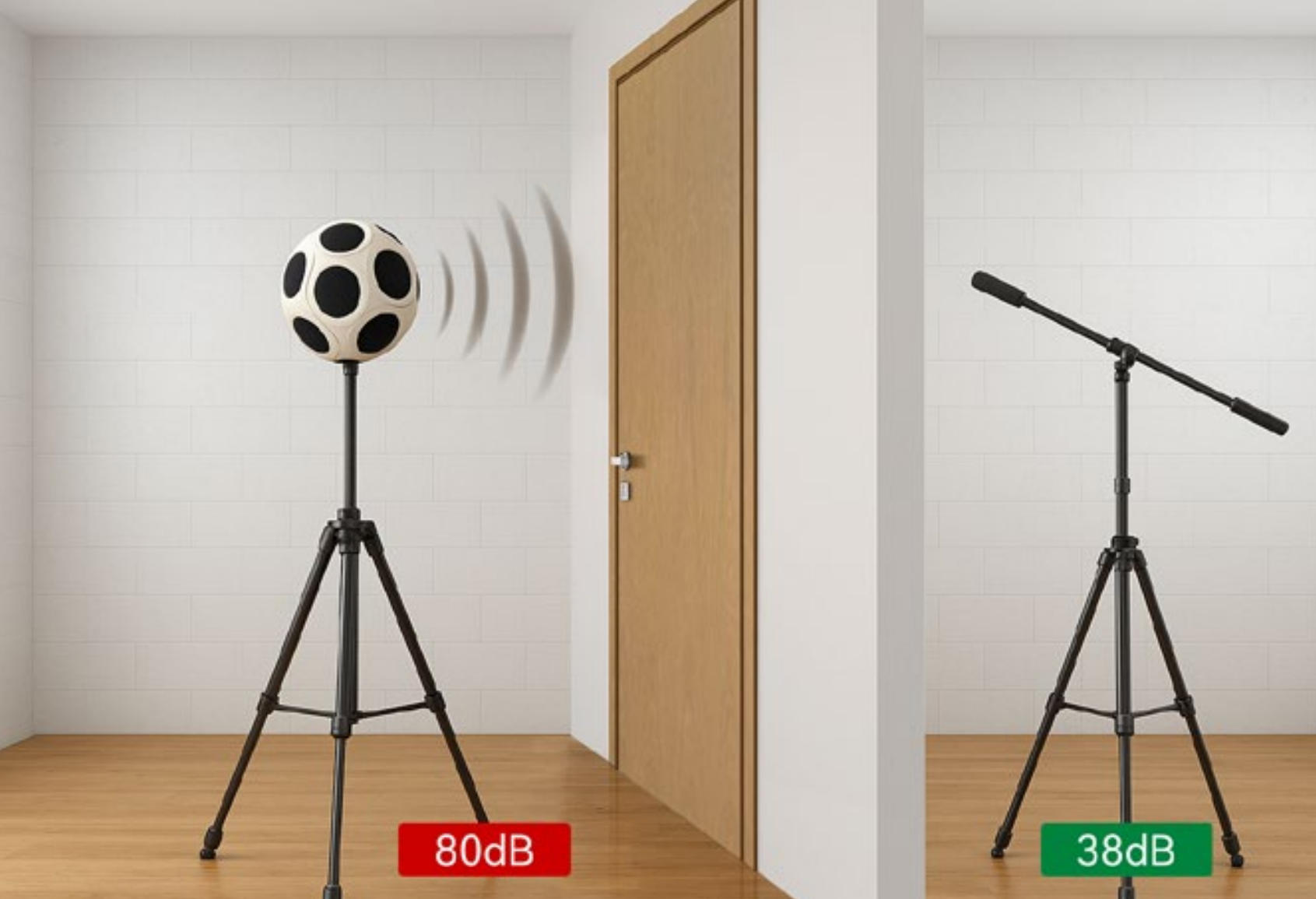
Field note: field-measured results (FSTC) typically run 5–7 dB below laboratory values due to flanking paths and installation variables.
The Series
Engineered — and rated — as one assembly
Forest Bright acoustic doors are supplied as complete assemblies: door leaf, frame, perimeter seals, and automatic door bottom — because that is how acoustic performance actually works. Every rating below is a third-party laboratory result for the full operable assembly, tested at Intertek to ASTM E90 / E413.
| Model | STC | Fire rating (optional) | Typical applications |
|---|---|---|---|
| STC3220A1 | 32 | Non-rated / 20-min | Hotel guestroom entry |
| STC3200B4 | 32 | Non-rated | Hotel guestroom entry |
| STC3420B1 | 34 | Non-rated / 20-min | Hotel guestroom entry |
| STC3490MN | 34 | 60-min / 90-min | Hotel guestroom entry |
| STC3520A2 | 35 | Non-rated / 20-min | Premium guestrooms, meeting rooms |
| STC3500B2 | 35 | Non-rated | Premium guestrooms, meeting rooms |
| STC3545C2 | 35 | 45-min | Hotel guestroom entry |
| STC3720B3 | 37 | Non-rated / 20-min | Premium guestrooms, meeting rooms |
| STC3745D1 | 37 | 45-min | Meeting rooms, boardrooms |
| STC3945C3 | 39 | 45-min | Boardrooms, premium suites |
| STC4045D1 | 40 | 45-min | Boardrooms, premium suites |
| STC4245D1 | 42 | 45-min | Premium suites, high-performance rooms |
Tested assembly constructions, seal sets, and Intertek report numbers for every model are in the Acoustic Door Solutions catalog. Configurations without a third-party report are quoted on request, with the documentation path made explicit before you specify.
What makes up an acoustic assembly
A section view: door leaf, frame, perimeter seals, and automatic door bottom — each part closes one of the paths sound travels through.
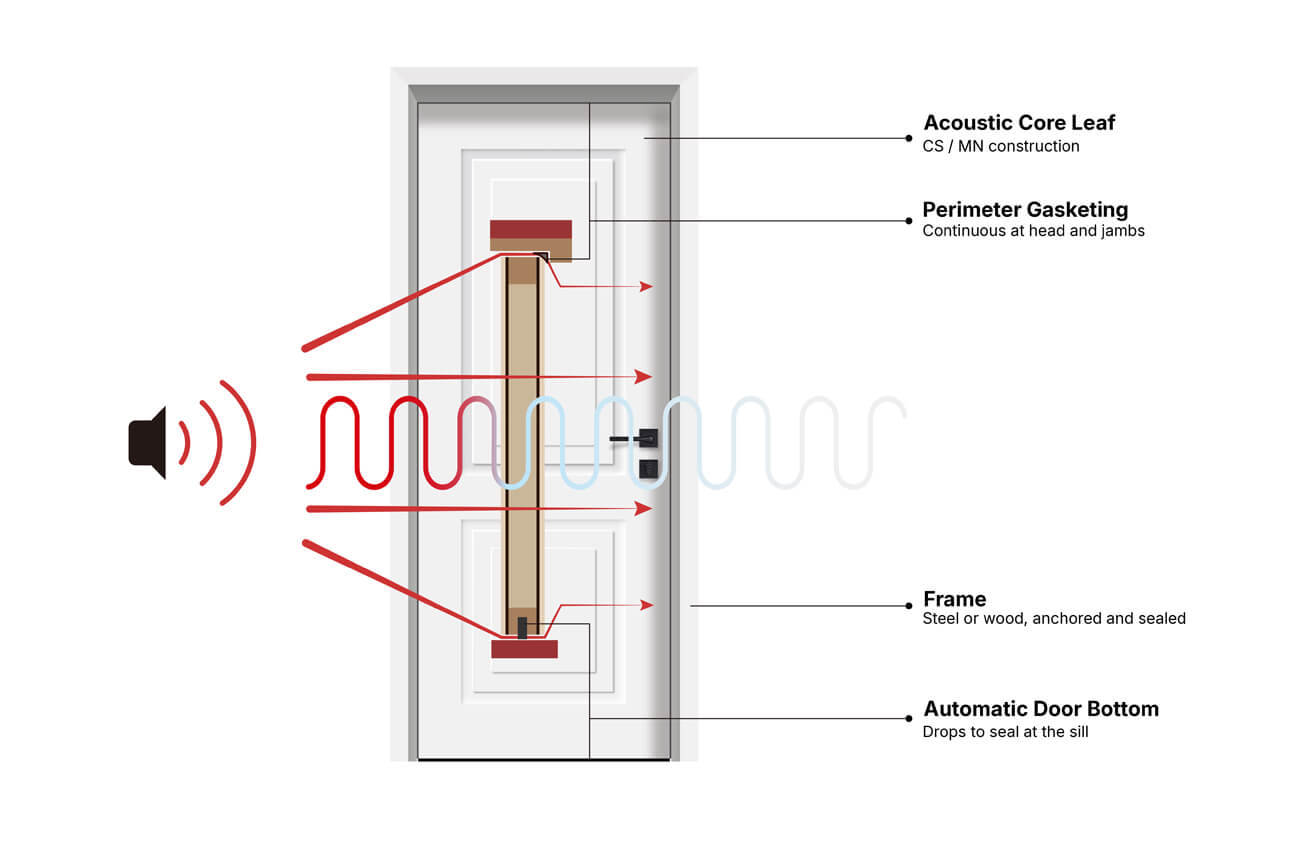
STC is measured on the complete assembly — leaf, frame, and seals together — per ASTM E90 / E413.
Building to an acoustic spec?
Send your door schedule — we'll return tested assembly configurations, opening by opening. STC values and test reports are under Certifications & Test Data.
