
Table of Contents
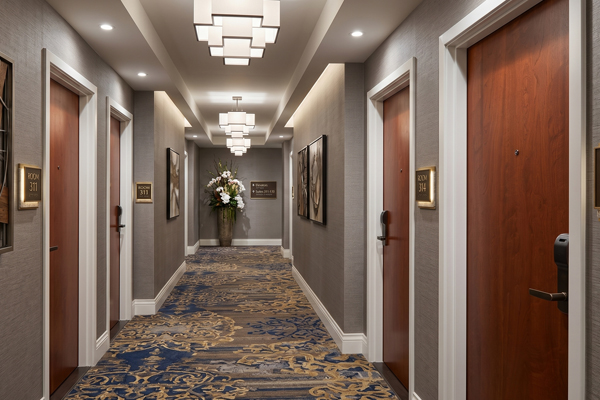
Walk into any upper-midscale or luxury hotel in the United States, and the guestroom door is one of the first tactile impressions a guest forms. Before they touch the bed linen or test the shower pressure, they push open that door. In that single moment, the surface finish—its color, grain, sheen, and texture—communicates the brand promise of the entire property.
For architects, interior designers, procurement managers, and hotel owners, selecting the right wood finish for architectural doors is far more consequential than a purely aesthetic decision. The finish determines long-term maintenance costs, compliance with fire and acoustic codes, brand consistency across hundreds of identical openings, and total installed cost over a 10- to 15-year lifecycle.
The three dominant finish categories in today’s US hospitality market—stain grade wood veneer, paint grade MDF/HDF, and high-pressure decorative laminate (HPDL)—each carry distinct performance profiles. Choosing the wrong one for your project context is a costly mistake that shows up not in the specification phase but years later, in guest complaints, accelerated replacement cycles, or failed inspection reports.
This guide unpacks each option with the technical depth and market-informed perspective that procurement professionals and design teams actually need.
Why the Finish Decision Is Also a Systems Decision
In commercial hospitality construction, doors are not standalone products—they are assemblies. The finish on the door face must coordinate with the door core material, frame type, hardware, fire rating requirements, and acoustic performance specification. A finish choice that ignores these upstream and downstream variables leads to re-specification, project delays, and cost overruns.
Consider a full-service hotel project targeting a STC 35 acoustic rating for guestroom entry doors—the standard minimum for premium hotel rooms under commonly cited hospitality benchmarks. That requirement immediately constrains your core selection. You’ll need a composite sound core or multi-layer composite construction, and certain finishes bond and perform differently across those core substrates. Similarly, if the local building code mandates a UL 10C 45-minute positive-pressure fire rating, your finish must be compatible with that rated assembly.
The most effective procurement approach treats finish selection and core/assembly selection as a single integrated specification exercise—not two separate decisions made by different teams at different times.
Stain Grade Wood Veneer: The Benchmark for Upscale and Luxury Properties
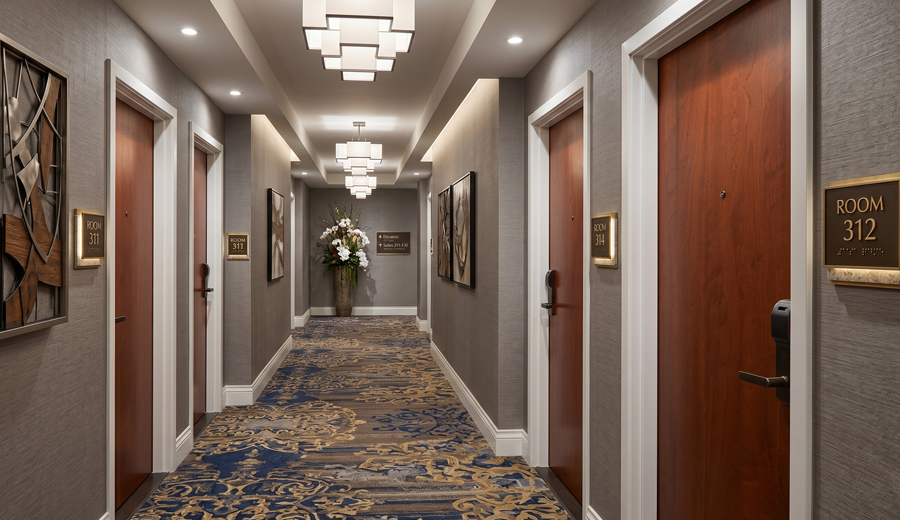
Natural wood veneer remains the material of choice for four- and five-star hospitality properties where authenticity and warmth are non-negotiable brand attributes. A properly specified veneer door delivers a visual and tactile quality that no manufactured surface has fully replicated—the variation in grain, the depth of stain, the way light reads differently at different angles.
Construction and Performance Specifications
Forest Bright’s stain grade veneer flush doors are built to a 5-ply bonded core construction, with WDMA A or AA grade face veneers finished to WDMA TR-6 standards using catalyzed polyurethane factory-applied coatings. The HDF crossbanding layer stabilizes the assembly and provides a consistent bond surface, while LVL stiles and rails deliver the structural rigidity required for high-cycle commercial use.
Core options for veneer doors include particleboard, agrifiber, LSB, composite sound core, and mineral core—each carrying different fire and acoustic performance profiles:
| Core Type | STC Rating | Fire Rating (UL 10C) | Max Single Door Size |
|---|---|---|---|
| Particleboard / LSB | STC 30–32 | 20-minute | 4′ × 9′ |
| Multi-layer Composite | STC 36 | 45- / 60-minute | 4′ × 8′ |
| Composite Sound Core | STC 42–45 | 20- / 45-minute | 4′ × 8′ |
| Mineral Core | STC 35 | 45- / 60- / 90-minute | 4′ × 8′ |
Veneer Species and Stain Color Options
Forest Bright offers a broad palette of factory-applied stain colors on oak and walnut veneer substrates, including Ice Oak, Light Ice Oak, Clay Gray Oak, Natural Oak, Walnut Oak, Teak Oak, Black Oak, Dark Wenge Oak, Light Clay Gray Oak, and Natural Black Walnut. Reconstituted veneer matching options are also available for projects requiring absolute consistency across large door quantities—a practical necessity on a 300- or 400-room hotel where natural grain variation in sawn veneer would be visually disruptive.
Factory finishing under controlled humidity and temperature conditions consistently outperforms field-applied finishes in commercial applications—a factor that becomes especially relevant in coastal climates where moisture migration is a real-world durability concern.
Paint Grade Doors: Precision, Versatility, and Budget Efficiency
Paint grade flush and stile-and-rail doors occupy a large and growing segment of the US commercial hospitality door market—and for good reason. When a hotel brand’s design language calls for crisp white corridors, bold-color accent doors, or a minimalist monochromatic aesthetic, paint grade construction is the most cost-effective and technically reliable path to achieving it.
How Forest Bright Solves the Paint Grade Crack Problem
Traditional white stile-and-rail doors built with mortise-and-tenon joinery are notorious for cracking at the joint lines after years of daily use—a particularly visible and damaging defect in painted surfaces where color uniformity is the entire visual premise. Forest Bright addresses this structural vulnerability with a proprietary manufacturing innovation: the stile-and-rail profile is carved directly into a single continuous sheet of HDF, which is then pressed together with the door core. This eliminates the mechanical joint that causes cracking, delivering a paint surface that holds its integrity across a commercial-use lifecycle.
Paint grade flush doors use high-density fiberboard as the substrate, delivering an exceptionally smooth surface that accepts primer and paint without telegraphing core texture. Factory-applied primer or catalyzed polyurethane finishes meet WDMA OP-6 standards, ensuring consistent color, sheen, and tint across an entire project’s door package.
Fire ratings of 20, 45, 60, and 90 minutes are available under UL 10C positive-pressure testing—a critical specification for corridor and egress openings in full-service hotels. Sound cores achieve up to STC 42, making paint grade doors a viable choice even for noise-sensitive applications like premium hotel rooms in urban locations.
HPDL Laminate Doors: Durability Engineered for High-Traffic Environments
High-pressure decorative laminate (HPDL) doors have evolved significantly from the utilitarian reputation they carried in earlier generations of commercial construction. Today’s HPDL surfaces—sourced from leading manufacturers including Wilsonart and Formica—offer sophisticated wood-look patterns, solid colors, and metallic effects that can closely replicate the visual warmth of natural veneer while delivering a surface hardness and abrasion resistance that no real wood finish can match.
The Case for Laminate in Select-Service and Extended-Stay Properties
For select-service hotel brands, airport hotel properties, and extended-stay concepts where doors absorb punishing daily traffic from luggage carts, housekeeping equipment, and guests in a hurry, HPDL offers a compelling value proposition. The surface resists scratching, moisture penetration, and staining far more effectively than painted or stained wood—translating directly into lower annual maintenance expenditures and a longer replacement cycle.
Forest Bright’s HPDL flush doors are built on a 5-ply bonded core with PVC edgebanding matched to the laminate face color, and the same core options and fire ratings available across the veneer line—including sound cores up to STC 42 and fire ratings from 20 to 90 minutes under UL 10C. A design innovation specific to Forest Bright’s HPDL line is the availability of adjustable jambs and casings wrapped in matching HPDL, delivering a fully integrated opening assembly where every visible surface carries a consistent color and texture. This detail—frequently overlooked in specifications—eliminates the visual inconsistency between door face and frame that is a common quality complaint on laminate door projects.
Appearance consistency is another structural advantage. Unlike natural wood veneer, where grain variation is an inherent characteristic that requires careful matching on large projects, HPDL delivers identical surface appearance from door one to door four hundred. For franchised hotel brands with strict visual brand standards, this consistency is a specification requirement, not a preference.
How to Choose: A Decision Framework for Design and Procurement Teams
No single finish category is universally superior. The right choice is a function of six variables operating simultaneously: project tier and brand standard, acoustic performance requirement, fire rating requirement, volume and consistency demands, lifecycle cost target, and lead time constraint.
| Project Profile | Veneer | Paint Grade | HPDL |
|---|---|---|---|
| Luxury / Upper-Upscale Hotel | ✔ Best | Good | Selective |
| Full-Service / Upscale Hotel | ✔ Best | ✔ Best | Good |
| Select-Service / Budget Hotel | Selective | Good | ✔ Best |
| STC 42+ Acoustic Requirement | ✔ | ✔ | ✔ |
| 90-Min Fire Rating Required | ✔ (Mineral) | ✔ (Mineral) | ✔ (Mineral) |
| High-Wear / High-Traffic Corridors | Selective | Good | ✔ Best |
It is also worth noting that these categories are not mutually exclusive within a single project. A common and highly effective specification strategy for full-service hotels uses veneer for guestroom entry doors (high visibility, guest-facing, brand-defining), paint grade for bathroom and connecting doors (clean aesthetic, cost-efficient), and HPDL for back-of-house and service corridor doors (maximum durability, lowest maintenance burden). This layered approach optimizes the total door package for both aesthetic impact and lifecycle economics.
Specifications in Action: Real Hospitality Projects
Abstract specification comparisons only go so far. Real project outcomes reveal how finish decisions perform under the pressures of brand compliance, building code, and construction schedule.
At CitizenM Los Angeles Downtown—a 420-room modular-design hotel developed with Gensler—Forest Bright supplied all interior wood doors to an exacting technical specification: UL 45-minute fire-rated entry doors, STC 42 acoustic performance, and TPA ULEF-compliant low-formaldehyde materials. The project demanded absolute consistency across a large door quantity, with no tolerance for finish variation between rooms. The HPDL specification made this achievable within the project’s compressed construction schedule.
At Hilton Garden Inn – Kuanzhai Alley (167 rooms, Chengdu), Forest Bright delivered a full acoustic door package aligned with Hilton Garden 3.0 brand standards—customized white oak veneer finish, 30-minute fire rating, STC 35 lab-tested performance with field-measured FSTC 30+. The natural oak veneer finish was selected to complement the property’s warm, contemporary-traditional design language—a judgment call that only veneer can execute with full authenticity.
These projects illustrate a consistent principle: the right finish choice is inseparable from the full assembly specification, the brand standard, and the operational context of the property.
Conclusion: Finish Is Strategy, Not Just Style
The choice between wood veneer, paint grade, and high-pressure decorative laminate is not a stylistic preference to be resolved by a mood board. It is a strategic decision that affects fire compliance, acoustic performance, maintenance cost, brand consistency, and guest experience across the full operational life of a hospitality property.
The most successful hospitality door specifications begin with a clear project brief—property tier, brand standard, applicable fire and acoustic codes, door quantity, and total installed cost target—and work systematically from there to a finish and core assembly that delivers on every requirement simultaneously.
Forest Bright’s architectural wood door program is built to support exactly this kind of integrated specification process, from initial design consultation through factory production, hardware coordination, and on-time delivery. All doors meet or exceed WDMA and AWI standards, with fire ratings tested under NFPA 252 (2012), UBC 7-2, and UL 10C, and FSC-certified material options available for sustainability-focused projects.
Ready to Specify?
Talk to a Forest Bright Door Specialist
Whether you’re specifying a 50-room boutique hotel or a 500-room convention property, our team provides technical guidance, code-compliant assemblies, and complete project coordination from design through delivery.
