
Table of Contents
For architects and contractors specifying doors for hotels, hospitals, schools, and office towers, a warped door is more than a cosmetic flaw — it’s a failed seal, a fire-rating violation, and a callback. This guide breaks down the bonded, multi-layer construction method that keeps commercial wood doors flat for decades, and how to recognize it on a cut sheet.
The Warping Problem in Commercial Buildings
A hotel guestroom door that bows at the latch side no longer seals against sound or smoke. A hospital corridor door that twists drags against its frame, slowing emergency egress and stressing hardware. In high-frequency commercial environments, even a small amount of warp compounds quickly — and once a solid-looking door starts to move, it rarely moves back.
Wood is a living material. It absorbs and releases moisture depending on temperature, humidity, and exposure on each face — a door installed between a humid corridor and a drier guestroom is under constant, asymmetric stress. The question for specifiers is not whether wood moves, but whether the door’s internal construction is engineered to keep that movement balanced.
Anatomy of a 5-Ply Bonded Core Door
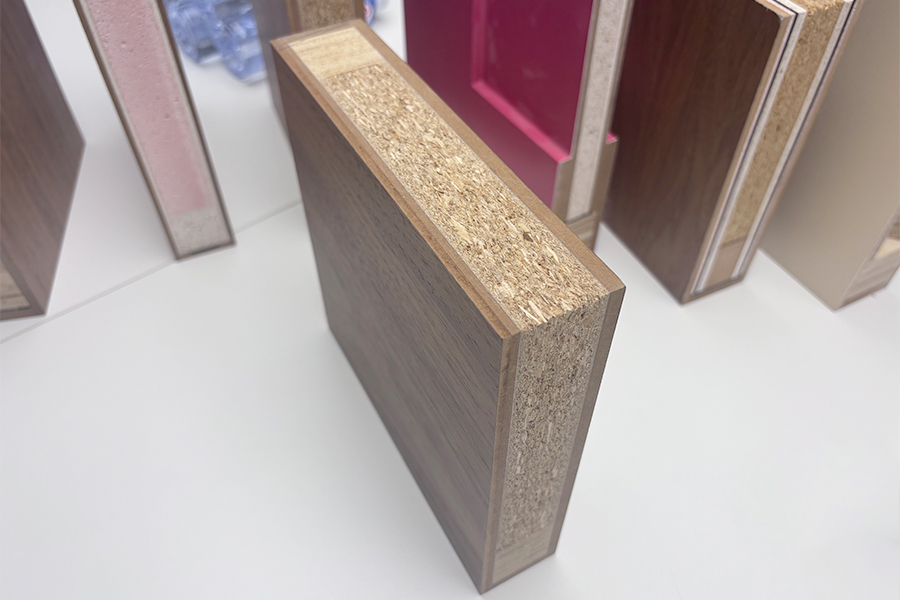
Forest Bright’s stain grade veneer and HPDL flush doors are built on a 5-ply, bonded core construction. Reading from one face to the other, the layers are:
| Layer | Material | Function |
|---|---|---|
| 1 — Face | Wood veneer or HPDL | Visible surface, finish, and design |
| 2 — Crossband | High Density Fiberboard (HDF) | Separates face from core, stabilizes grain direction |
| 3 — Core | Particleboard, agrifiber, LSB, mineral, or sound core | Bulk, weight, and performance (fire, acoustic, density) |
| 4 — Crossband | High Density Fiberboard (HDF) | Mirrors layer 2 to keep the panel balanced |
| 5 — Face | Wood veneer or HPDL | Mirrors layer 1 on the opposite side |
This center core is then framed on all four edges by LVL (laminated veneer lumber) stiles and rails — 1-3/8″ LVL top and bottom on Forest Bright’s flush door line — which form the structural perimeter the core sits inside.
Why Balanced Construction Stops Warping
1. Symmetry Cancels Out Movement
The 5-ply layup is built as a mirror image around its centerline: face matches face, crossband matches crossband. When one face absorbs moisture and tries to expand, the identical layer on the opposite side resists with equal and opposite force. A door with mismatched or single-sided construction has no such counterbalance — it simply bends in the direction of least resistance.
2. Bonded Core Eliminates Internal Gaps
Forest Bright’s stiles and rails are bonded to the core for a uniform bond between all components, meeting WDMA/AWS custom and premium grade quality standards. Cores and LVL framing are precisely bonded in a gap-free state, and face panels go through multiple full-surface lamination processes. A gap-free bond matters because any void inside a door becomes a pocket where moisture can collect unevenly — and uneven moisture is the direct cause of uneven movement.
3. LVL Framing Adds Structural Resistance
LVL is engineered specifically for its load-bearing predictability. As the structure surrounding the core, it gives the door outstanding bending resistance and high pull-out strength for hardware screws — which is also why hinges and closers stay tight on a 5-ply LVL-framed door long after a solid-lumber-framed door has loosened.
Choosing the Right Core for the Application
The 5-ply construction method stays constant; the core inside it changes by project requirement. The same bonded, balanced layup applies across every core option:
| Core Type | Typical Use |
|---|---|
| Particleboard Core | General interior and mainstream commercial doors |
| Agrifiber Core | Sustainable, low-formaldehyde builds, LEED-oriented projects |
| LSB Core | Premium residential and entry doors needing anti-warp strength |
| Mineral Core | Fire-rated doors, healthcare environments |
| Sound / Composite Core | Hotel guestrooms and acoustic-sensitive spaces, up to STC 42 |
Proof, Not Promises: How This Construction Is Tested
A construction method is only as credible as the testing behind it. Forest Bright’s bonded 5-ply doors are produced to meet or exceed WDMA and AWI architectural flush wood door standards, and are evaluated against:
- WDMA TM-7 — 1,000,000-cycle endurance testing for long-term durability under repeated opening and closing.
- ANSI/WDMA I.S. 1A-13 — Forest Bright’s solid-core doors are rated for Extra Heavy Duty, the system’s highest performance tier, covering airports, hospitals, and schools.
- UL 10C positive-pressure fire testing — 20-, 45-, 60-, and 90-minute fire-rated configurations, consistent with NFPA 252 and UBC 7-2.
- Third-party verification — testing conducted through Intertek, an internationally recognized independent laboratory.
What This Means for Specifiers and Contractors
Warping isn’t always visible at substantial completion — it shows up six months to two years into occupancy, often as a callback that falls on the general contractor or owner. Specifying a verified bonded, 5-ply construction up front is the cheapest insurance against that outcome. When reviewing cut sheets, look for explicit language on:
- Bonded core construction with stated WDMA/AWS grade compliance
- LVL stile and rail dimensions (not generic “solid wood frame” language)
- HDF crossbanding called out as a distinct layer
- Independent endurance and fire test data, not just manufacturer claims
Frequently Asked Questions
What does 5-ply construction mean in a commercial wood door?
A 5-ply door is built in five bonded layers around a central core: a face layer, an HDF crossband, the core, a second HDF crossband, and the opposite face layer — framed on all sides by LVL stiles and rails.
Why do commercial wood doors warp?
Warping typically results from uneven moisture absorption between the two faces, internal voids in the core bond, or a perimeter frame that lacks the stiffness to resist the wood’s natural movement over time.
What core material is most resistant to warping?
Resistance comes less from any single core material and more from a bonded, gap-free construction. Forest Bright applies the same full-surface lamination process across particleboard, agrifiber, LSB, mineral, and sound core options, framed with LVL stiles and rails.
Specifying a Project That Can’t Afford a Warped Door?
Talk to Forest Bright’s technical team about 5-ply bonded core construction, fire ratings, and acoustic performance for your next hotel, healthcare, education, or office project.
