
Table of Contents
When a hotel corridor door is scratched, a hospital door coating peels, or a school classroom door finish goes dull after one semester — the root cause is almost always the same: the finish was applied in the field, under conditions nobody controlled.
UV-cured factory finishes eliminate that variable. Applied and cured under controlled factory conditions before a door ever reaches the jobsite, they deliver a surface quality that field finishing simply cannot replicate at scale. This guide explains what that means in practice — for the hotel procurement manager, the healthcare specifier, and the general contractor managing a 300-room renovation on a tight schedule.
Cure Time
Seconds
UV-cured coatings harden almost instantly — eliminating the multi-day dry time required by field-applied coatings.
Surface Hardness
Pencil 2H+
Fully cross-linked UV films achieve high pencil hardness ratings — significantly outperforming most air-dried field coatings.
Schedule Impact
Zero Days
Pre-finished doors install immediately upon delivery. No on-site drying, no re-coat scheduling, no finish-related delays.
What Is UV-Cured Finishing?
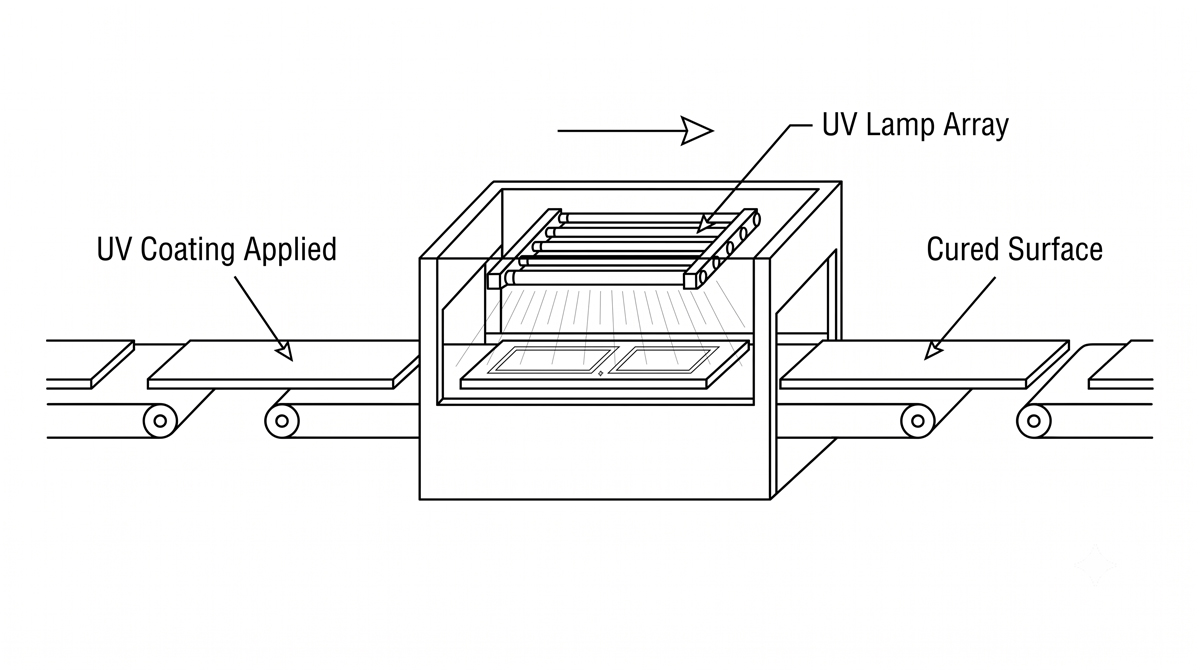
UV curing is a photochemical process. A liquid coating — typically a UV-reactive resin — is applied to the door surface in a precisely measured film. The panel then passes under high-intensity ultraviolet lamps, triggering a near-instant cross-linking reaction that converts the liquid into a fully solid, tightly bonded film.
Unlike solvent-based or waterborne field coatings, which cure by evaporation over hours or days, the UV process is complete in seconds — and because it happens inside a factory under controlled temperature, humidity, and contamination conditions, the result is dramatically more consistent than anything achievable in the field.
Five Reasons to Specify a UV-Cured Factory Finish
Exceptional Surface Hardness & Abrasion Resistance
The photochemical cross-linking in UV curing creates a molecular film density that air-dried and solvent-evaporation coatings cannot match. In high-traffic corridors — hotel floors, hospital hallways, school entrances — this translates directly to a finish that resists housekeeping cart scuffs, hand contact wear, and daily cleaning cycles without dulling or cracking over years of use.
Consistent Appearance Across Large Quantities
A 200-room hotel requires every guestroom door to look identical. With field finishing, sheen variation, color drift between batches, and uneven grain penetration are routine problems. Factory UV finishing applies the same film weight under the same conditions to every door — ensuring the door on floor 1 matches the door on floor 22, every time.
Low VOC & Green Building Compliance
UV-cured coatings cure by photochemical reaction, not solvent evaporation — which means they release very low volatile organic compounds. This supports LEED v4 Indoor Environmental Quality credits, WELL Building Standard requirements, and increasingly strict state-level VOC regulations. For owners pursuing sustainability certifications, specifying a UV-cured factory finish simplifies documentation and review.
No On-Site Finishing — Faster Project Schedules
Pre-finished doors arrive at the jobsite ready to hang. There is no waiting for on-site coating crews, no scheduling around dry-time windows, and no risk of dust or humidity contaminating a wet finish during installation. For hotel renovations where every closed room is lost revenue, this schedule compression is a material cost advantage — not just a convenience.
Manufacturer Warranty Integrity
Field-applied finishes are typically outside the scope of a door manufacturer’s warranty. A factory-applied finish is part of the manufactured assembly — it is tested and certified alongside the door substrate, core, and edge construction. Any finish defect is the manufacturer’s responsibility to remedy, not an open question between the painter, the contractor, and the door supplier.
Factory Finish vs. Field Finish: A Direct Comparison
The table below summarizes the key practical differences for commercial project teams.
| Criteria | UV-Cured Factory Finish | Field-Applied Finish |
|---|---|---|
| Application environment | Controlled factory conditions | Variable — temperature, humidity, dust |
| Cure time | Seconds (UV lamp) | Hours to days (evaporation) |
| Surface hardness | Very high (fully cross-linked) | Moderate — depends on product and conditions |
| Color / sheen consistency at scale | Batch-to-batch uniform | Prone to variation between applicators |
| VOC emissions | Very low | Moderate to high (solvent-based products) |
| Schedule impact at install | None — install immediately | Adds days to project schedule |
| Warranty coverage | Included in manufacturer warranty | Typically excluded from door warranty |
| Sheen options | Matte, satin, high-gloss | Variable — applicator dependent |
Why It Matters by Market
The case for UV-cured factory finishing shifts depending on what your project demands most. Here is what each market segment gains.
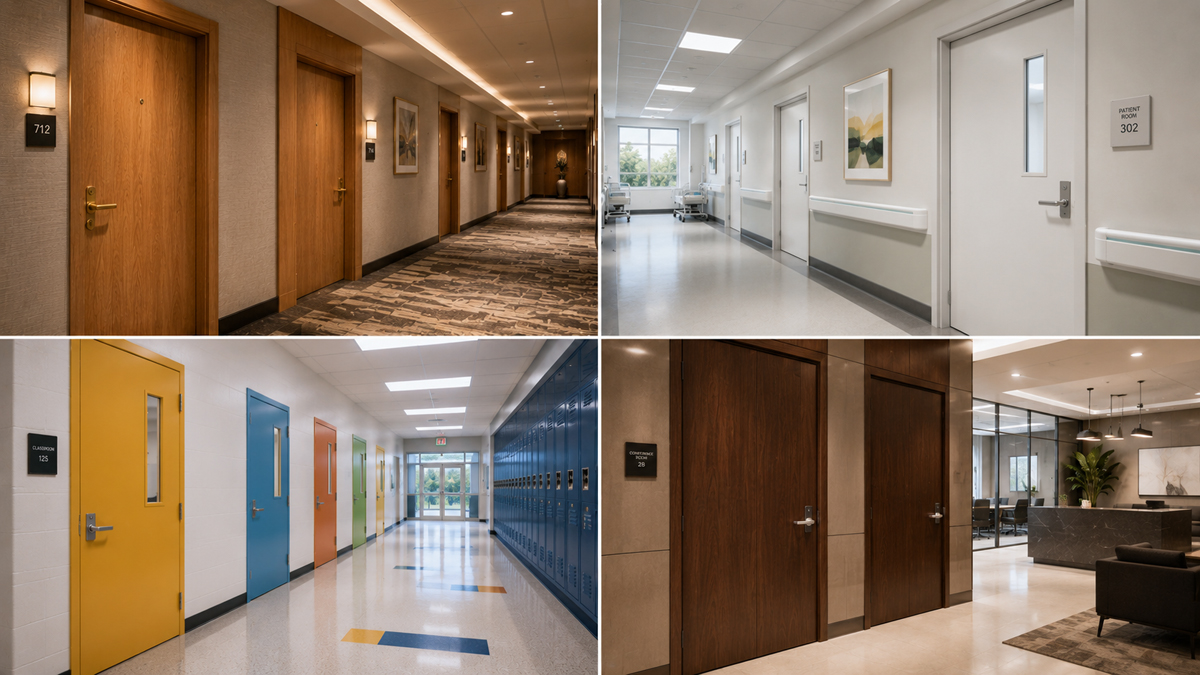
Hotels & Hospitality
Brand Consistency at Scale
A 400-room hotel renovation cannot tolerate sheen or color variation between floors. UV-cured factory finishing ensures every door — guestroom, corridor, and BOH — leaves the factory identical. Renovation downtime is minimized because pre-finished doors install the day they arrive.
Healthcare & Senior Living
Disinfectant Resistance
Hospital corridors are cleaned daily with alcohol, chlorine, and hydrogen peroxide solutions. Hard UV-cured surfaces resist chemical attack and repeated wiping without dulling, peeling, or delaminating — a failure mode common in softer field-applied finishes within one to two years of clinical use.
Education
Impact & Wear Durability
K–12 classroom doors are kicked, bumped, and handled hundreds of times per day. A UV-cured factory finish on a properly constructed door core resists the kind of localized impact and abrasion that strips field-applied finishes within a single academic year — reducing maintenance costs across the full facility lifecycle.
Offices & Public Buildings
LEED & WELL Compliance
Corporate headquarters and government projects increasingly specify low-VOC interior finishes as part of LEED v4 or WELL v2 certification packages. UV-cured factory finishes support Indoor Environmental Quality credits and simplify the material documentation required during certification review.
Choosing the Right Sheen Level
Factory-finished architectural wood doors are available in matte, satin, and high-gloss. The correct choice is determined by the design intent of the space, the type of veneer, and the occupancy’s functional demands.
Matte
Low reflectance, natural feel
Ideal for healthcare, senior living, and premium residential where warm, non-clinical texture is a design priority. Minimizes glare in brightly lit corridors.
Satin / Semi-Gloss
Balanced performance & appearance
The most widely specified sheen level for hotel guestroom doors, corporate offices, and schools. Moderate reflectance enhances grain detail while offering strong scuff and cleaning resistance.
High-Gloss
Maximum visual impact
Suited for statement entries, hotel lobby doors, and luxury residential. Best paired with paint-grade or fine veneer surfaces where a mirror-smooth finish is the intended design expression.
What to Specify — and What to Ask Your Manufacturer
Specifying a factory finish on your door schedule is straightforward, but the quality of the outcome depends on asking the right questions before you commit to a supplier.
Is the finish part of the manufacturer’s warranty?
Ask for the warranty document in writing, confirming coverage of both the substrate and the applied finish.
Can you provide VOC documentation for LEED review?
Request the finish product data sheet and VOC content test report for inclusion in the sustainability submittal package.
How do you validate color and sheen consistency batch-to-batch?
Request the manufacturer’s quality control process for finish batches, including any spectrophotometric or visual inspection protocols.
Can I see a physical finish sample before production?
A reputable manufacturer will provide finish samples on the actual veneer species specified — not generic color chips — for approval before production begins.
Has the finish been tested on fire-rated assemblies?
Confirm that the factory finish has been applied and approved on UL-listed doors within the tested assembly — not added after certification.
What abrasion or scuff resistance tests have been conducted?
Ask for results from relevant surface hardness or abrasion tests to verify durability claims in writing before specifying.
Forest Bright
Factory Finishing as Part of a Complete Door System
At Forest Bright, surface finishing is not an add-on. It is integrated into the same factory workflow as core selection, veneer matching, edge profiling, and hardware pre-machining. Every door leaves our 30,000 m² facility with its finish already applied, inspected under ISO 9001 quality management, and matched to the project-approved sample on file.
We offer matte, satin, and high-gloss sheens across natural wood veneers, engineered veneers, and paint-grade surfaces — in any color specified by the architect or designer. Finish samples on the specified veneer species are provided before production begins, and physical mock-up approval is available for large hospitality and multi-family projects.
Sheen Options
Matte · Satin · High-Gloss
Quality Standard
ISO 9001 Certified
Compliance
CARB Phase 2 · TSCA Title VI
Fire Ratings
UL 10C · 20/60/90/120 min
Frequently Asked Questions
What is a UV-cured finish on an architectural wood door?
A UV-cured finish is a coating applied to the door surface and hardened almost instantly by ultraviolet light in a controlled factory environment. The result is an exceptionally hard, cross-linked film that resists abrasion, scratching, and impact in high-traffic commercial environments.
How does UV-cured factory finishing compare to field finishing?
Factory-applied UV-cured finishes deliver tighter quality control, consistent sheen and color across large quantities, and faster project schedules since doors arrive pre-finished and ready to hang. Field finishing introduces risks from temperature, humidity, dust, and applicator variability that can compromise finish quality and delay handover.
Are these finishes appropriate for healthcare environments?
Yes. Hard, non-porous UV-cured surface films withstand repeated cleaning with standard hospital disinfectants and maintain their integrity over long-term use. This makes them a strong choice for patient room corridors, exam rooms, and clinical spaces where surface durability and hygiene are both priorities.
Can UV-cured finishes support LEED v4 certification?
UV-cured finishes are typically very low in VOCs because curing relies on photochemical reaction rather than solvent evaporation. This can contribute to LEED v4 Indoor Environmental Quality credits. Always verify specific VOC content with your manufacturer’s documentation and test reports before including in a submittal package.
What sheen levels are available with factory-finished architectural wood doors?
Factory-finished architectural wood doors are available in matte, satin (semi-gloss), and high-gloss sheens. The correct choice depends on design intent, occupancy type, veneer species, and the desired level of light reflectance appropriate for the space.
Next Step
Request a Finish Sample for Your Project
Forest Bright provides finish samples on the specified veneer species — not generic chips — before production begins. Tell us your project type, veneer preference, and sheen requirement, and we will prepare samples for your approval.
