
Table of Contents
- What Is a Flush Wood Door, Structurally?
- What Is a Stile and Rail Door, Structurally?
- How Do Fire Ratings Compare Between the Two Constructions?
- Which Construction Offers Better Acoustic Performance?
- How Do Core Material Options Differ Between the Two?
- Which Construction Should You Specify by Project Type?
- What Should Be Confirmed Before Specifying Either Door Type?
- Frequently Asked Questions
Quick Answer
Flush doors are built around a bonded core with a flat, continuous face and support UL 10C fire ratings up to 90 minutes. Stile and rail doors are framed assemblies with visible stiles, rails, and infill panels, and are rated up to UL 10C 45 minutes. Both constructions are available with a sound core rated up to STC 42 — the deciding factor is usually fire rating range and architectural intent, not acoustic performance.
20–90 min
UL 10C range, flush doors
20–45 min
UL 10C range, stile & rail
STC 42
Max sound core rating, both
3-Year
Limited warranty, both
What Is a Flush Wood Door, Structurally?
A flush wood door is built around a single bonded core — particleboard, agrifiber, LSB, sound core, or mineral core — with stiles and rails bonded internally to that core rather than visible on the face. The result is a flat, continuous plane on both sides, finished with veneer, paint, or HPDL.
Forest Bright builds flush doors in 3-ply construction for paint-grade faces and 5-ply construction for stain-grade veneer and HPDL faces. In every grade, the stiles and rails are bonded to the core for a uniform bond across all components, meeting WDMA/AWI custom and premium grade quality standards.
| Flush Door Grade | Construction | Available Core Options |
|---|---|---|
| Paint Grade | 3-ply, HDF crossbanding, primer or catalyzed polyurethane finish (WDMA OP-6) | Particleboard, agrifiber, sound core, mineral core |
| Stain Grade Veneer | 5-ply, WDMA A/AA grade veneer face, catalyzed polyurethane finish (WDMA TR-6) | Particleboard, agrifiber, mineral core, sound core |
| HPDL | 5-ply, decorative laminate face (Wilsonart, Formica), PVC edgebanding | Particleboard, agrifiber, mineral core, sound core |
What Is a Stile and Rail Door, Structurally?
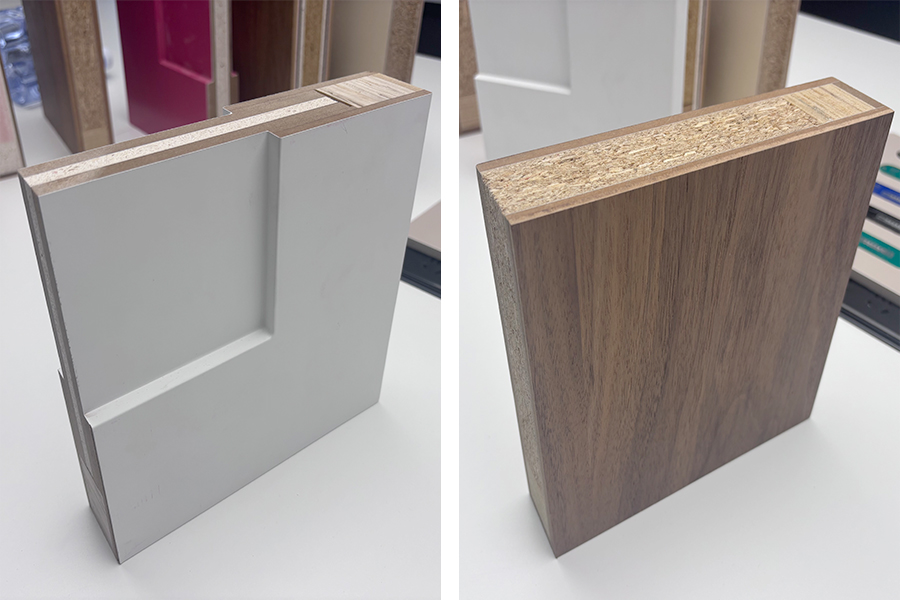
A stile and rail door is a framed door, not a flat panel. Vertical stiles and horizontal rails form a visible structural frame, and that frame holds infill panels, glass lites, or louvers — giving the door dimensional, architecturally traditional lines rather than a single flat plane.
Forest Bright offers two stile and rail grades, and the construction method differs meaningfully between them.
Paint Grade Stile & Rail
Traditional mortise-and-tenon stile and rail construction tends to crack at the joints over years of use. Forest Bright’s paint-grade construction instead carves the stile and rail profile into a single piece of HDF, then presses two of these carved skins around a door core panel — eliminating the joint-cracking failure point while preserving the look of a true stile and rail door.
Stain Grade Veneer Stile & Rail
This is a true framed construction: an LVL internal frame is wrapped in hardwood sticking and hardwood edge, with a veneered MDF panel set into the frame and an AA-grade wood veneer face. Customized panel and sticking profiles, glass or resin panel inserts, and matching hardwood or veneer edgebanding are all available.
How Do Fire Ratings Compare Between the Two Constructions?
Flush doors are rated to UL 10C positive-pressure fire ratings of 20, 45, 60, and 90 minutes. Stile and rail doors are rated to UL 10C 20 and 45 minutes only. Both are tested to NFPA 252 (2012) and UBC 7-2, with third-party certification through Intertek/Warnock Hersey.
| Fire Rating | Flush Door | Stile & Rail Door |
|---|---|---|
| 20-minute | ✓ | ✓ |
| 45-minute | ✓ | ✓ |
| 60-minute | ✓ | — |
| 90-minute | ✓ | — |
Specifiers should treat this as a hard constraint rather than a preference: if a corridor or stairwell opening requires a 60- or 90-minute rating, the flush door construction is the path that can meet it within the Forest Bright product line.
Which Construction Offers Better Acoustic Performance?
Neither construction has an acoustic advantage on paper. Both flush and stile and rail doors are available with a sound core option rated up to STC 42, the top of Forest Bright’s STC 30–42 acoustic range. For most projects, acoustic performance should not be the factor that decides between the two door styles — fire rating ceiling and design intent should drive that decision instead.
Where acoustic performance does matter is in the full assembly: door, frame, seals, and automatic door bottom together determine field performance, regardless of which construction is chosen.
How Do Core Material Options Differ Between the Two?
Flush doors offer the broader core menu because the entire face is one bonded panel: particleboard, agrifiber, LSB, sound core, and mineral core are all available across paint, veneer, and HPDL grades. Stile and rail doors carry their core inside the framed panel itself — an MDF panel core for standard paint-grade and stain-grade doors, or an engineered panel with mineral core where a 20- or 45-minute fire rating is required.
| Core Material | Flush Door | Stile & Rail Door |
|---|---|---|
| Particleboard core | ✓ | — |
| Agrifiber core | ✓ | — |
| LSB core | ✓ | — |
| Sound core (up to STC 42) | ✓ | ✓ |
| Mineral core (fire-rated) | ✓ | ✓ |
| MDF panel core (non-rated) | — | ✓ |
Which Construction Should You Specify by Project Type?
In practice, most commercial projects use both constructions in different zones of the building. Here is how the choice typically breaks down by sector.
Hotel & Hospitality
Guest room corridor doors typically specify flush construction with a sound core, supporting Hilton’s dual acoustic acceptance standard of lab STC ≥ 35 / field FSTC ≥ 30. Stile and rail doors suit lobby, ballroom, and suite entries where a designed, framed face supports the brand aesthetic.
Healthcare & Senior Living
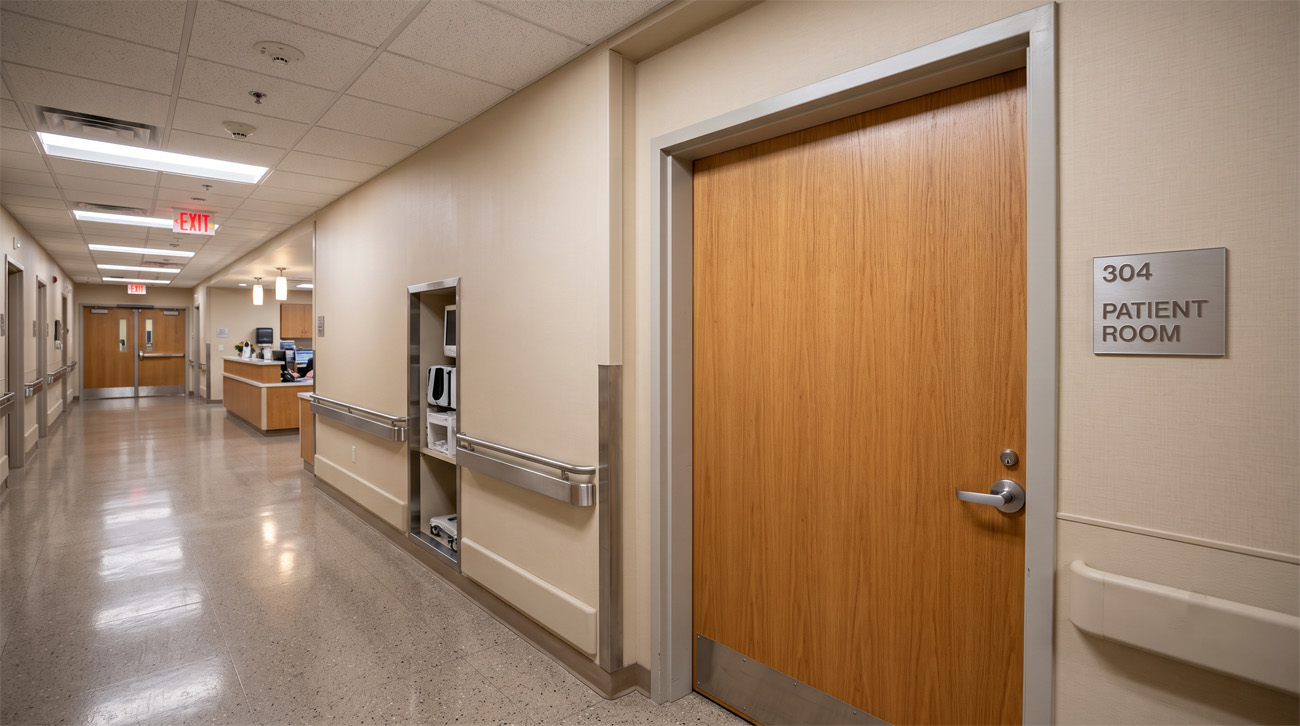
Patient room, exam room, and corridor doors lean toward flush construction with mineral core or HPDL faces, since the flat surface and higher available fire rating tier better suit infection-control cleaning protocols and code-driven corridor requirements.
Education
Classroom and corridor doors generally call for flush construction for durability and fire rating flexibility. Stile and rail doors with glass lite inserts can serve administrative offices, libraries, and entry vestibules where daylighting and visual character matter.
Office & Public Spaces
Back-of-house, tenant separation, and stairwell doors favor flush construction for fire rating headroom up to 90 minutes. Executive suites, conference rooms, and lobby entries are where stile and rail framing earns its place architecturally.
What Should Be Confirmed Before Specifying Either Door Type?
A short verification pass at the specification stage avoids the most common submittal rejections on both door constructions.
- ☐ Confirm the required fire rating tier is achievable in the chosen construction — flush up to 90 minutes, stile and rail up to 45 minutes.
- ☐ Confirm STC requirement and verify the sound core option is selected where acoustic performance is required.
- ☐ Confirm whether the design intent calls for a flat flush face or a framed, profiled stile and rail face.
- ☐ Confirm field finishing requirements — unfinished wood doors must be sealed on all six sides, including top and bottom, before installation.
- ☐ Confirm frame type pairing — wood, hollow metal, or aluminum frame — and rebate configuration.
- ☐ Confirm hardware machining requirements are factory-prepped to the hardware schedule.
- ☐ Confirm warranty terms — Forest Bright provides a limited three-year warranty against workmanship and material defects on both constructions.
Need Help Choosing the Right Door Construction for Your Project?
Send us your fire rating, acoustic, and design requirements and our team will recommend the right flush or stile and rail configuration — with documentation ready for submittal.
Frequently Asked Questions
What is the main structural difference between stile and rail doors and flush doors?
A flush door is a single flat panel built around a bonded core, with the stiles and rails functioning as internal LVL framing members hidden beneath a continuous face skin. A stile and rail door is a framed assembly where vertical stiles and horizontal rails form a visible frame around infill panels, glass, or louvers, creating a dimensional, traditionally styled face rather than a flat plane.
What fire ratings can stile and rail wood doors achieve?
Forest Bright stile and rail wood doors are rated to UL 10C positive-pressure fire ratings of 20 minutes and 45 minutes, tested to NFPA 252 (2012) and UBC 7-2, in both paint-grade and stain-grade veneer constructions.
What fire ratings can flush wood doors achieve?
Forest Bright flush wood doors are rated to UL 10C positive-pressure fire ratings of 20, 45, 60, and 90 minutes across paint-grade, stain-grade veneer, and HPDL constructions, tested to NFPA 252 (2012) and UBC 7-2.
Can a stile and rail door match the acoustic performance of a flush door?
Yes. Both Forest Bright stile and rail and flush doors are available with a sound core option rated up to STC 42, so acoustic performance is not the deciding factor between the two constructions; fire rating range and design intent typically are.
What core materials are used in flush wood doors?
Forest Bright flush wood doors are available with particleboard core, agrifiber core, LSB core, sound core, and mineral core options, allowing the core to be matched to fire rating, acoustic, and budget requirements on a project-by-project basis.
Which door construction is recommended for high-traffic commercial corridors?
Flush wood doors are generally specified for high-traffic commercial corridors such as hotel guest room corridors and healthcare wards because their core options support fire ratings up to 90 minutes and a flat face that is easier to clean and maintain at scale. Stile and rail doors are often reserved for lobbies, offices, and spaces where a framed, architectural face is part of the design intent.
