

Table of Contents
What STC rating should I specify for premium residential entry doors?
For premium residential entry doors in multi-family developments, specify a minimum of STC 35. Urban locations near major roads, transit lines, or mechanical rooms should target STC 37–40. Ultra-premium high-rise units or projects with particular noise-sensitivity requirements should reach STC 42. Forest Bright’s acoustic door series covers this full range with models FB-STC35 through FB-STC42, each tested by certified third-party labs to WDMA manufacturing specifications, with an optional 60-minute fire rating available on STC 40 and STC 42 models.
Why entry doors need a higher STC than interior doors
The minimum STC for a residential interior door — bedroom, study, walk-in closet — is typically specified around STC 25 to 30, and that rating reflects noise transmission between two finished interior spaces where flanking paths through structure are manageable. An entry door faces a fundamentally different acoustic challenge: it separates the unit from a building corridor, a lobby, or in some cases the outdoors, where noise levels are higher, less predictable, and include mechanical and structural sources that don’t respond to speech-range acoustic design.
The other practical reality is the lab-to-field gap. Field test results (measured as FSTC) are typically 5–7 dB lower than the laboratory STC, due to gap tolerances, flanking transmission through walls, and installation variability. An entry door specified at STC 30 may perform closer to STC 23 in practice — which is audible corridor speech at conversational volume. Specifying one tier higher than the minimum is how experienced specifiers build that margin back in.
Recommended STC by noise environment
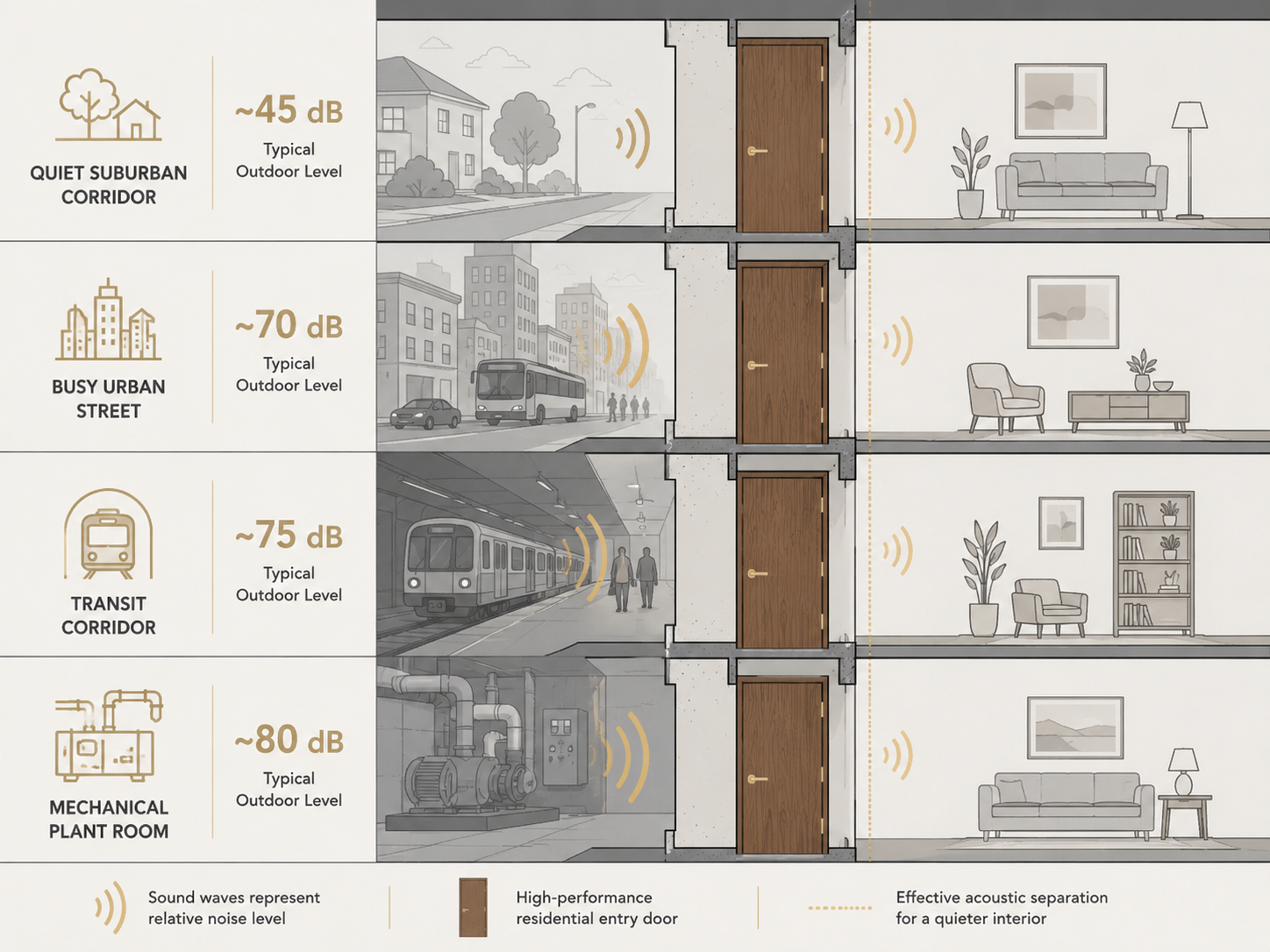
The right STC for a residential entry door is driven by the noise sources that door faces, not by the unit’s interior program. Use the scenarios below as a starting point, then confirm against the project’s acoustic consultant report where one is available.
Quiet corridor, low foot-traffic, no direct mechanical adjacency. STC 35 provides a comfortable buffer above the lab-to-field gap. Corresponds to Forest Bright model FB-STC35.
Units facing a busy road, transit stop, or active amenity corridor. Leaves meaningful headroom once the field gap is applied. Corresponds to Forest Bright model FB-STC37, designed for street-facing homes and theaters.
Units above active commercial, adjacent to elevator plant, or in high-density residential towers with active corridors. The 58 mm door leaf at STC 40 delivers meaningful in-use performance. Corresponds to Forest Bright model FB-STC40.
The top specification tier for projects where acoustic privacy is a brand promise or a contractual deliverable. Also the correct spec for hotel-branded residences where guest-room acoustic standards carry over. Corresponds to Forest Bright model FB-STC42, designed for studios, boardrooms, and premium suites.
Forest Bright acoustic entry door series: full specification
All six models below are built to WDMA manufacturing specifications and rated in both STC (ASTM E90 / E413, North America) and Rw (ISO 717-1, international). Full door assemblies — leaf, frame, and hardware — are tested by certified third-party labs. Fire rating is optional on lower models and available up to 60 minutes on STC 40 and STC 42.
| Model | Leaf Thickness | Acoustic Rating | Fire Rating (Optional) | Residential Entry Application |
|---|---|---|---|---|
| FB-STC30 | 50 mm | Rw / STC 30 | Non-fire / 30 min | Interior bedroom / quiet zone doors; not recommended for unit entry |
| FB-STC32 | 50 mm | Rw / STC 32 | Non-fire / 30 min | Standard-grade residential entry; minimum for non-premium applications |
| FB-STC35 | 50 mm | Rw / STC 35 | Non-fire / 30 min | Recommended minimum for premium suburban entry |
| FB-STC37 | 50 mm | Rw / STC 37 | Non-fire / 30 min | Recommended for mid-rise urban & street-facing |
| FB-STC40 | 58 mm | Rw / STC 40 | 60 min | Premium for high-rise urban, transit-adjacent |
| FB-STC42 | 58 mm | Rw / STC 42 | 60 min | Ultra-Premium for luxury, branded residences |
Source: Forest Bright Acoustic Door Solutions 2026. All models rated in both Rw (ISO 717-1) and STC (ASTM E90/E413). Full door assemblies tested by certified third-party labs to WDMA manufacturing specifications.
What actually determines entry door acoustic performance
An STC number on a spec sheet is a lab result for the full door assembly — leaf, frame, hardware, and sealing system working together under controlled conditions. The four factors below are what Forest Bright engineers when it builds toward a particular STC target; they are also the four factors that most commonly account for the gap between lab STC and field FSTC when assembly quality or specification is inadequate.
Multi-layer core construction
Forest Bright’s acoustic doors use a custom-developed multi-layer core that targets low-, mid-, and high-frequency transmission paths simultaneously. The 58 mm leaf on FB-STC40 and FB-STC42 adds mass at the composite level — mass is the single largest driver of broadband STC performance.
Three-side seal + auto drop seal
A triple-layer edge design on three sides closes the perimeter gap. An automatic door-bottom drop seal closes the threshold gap the instant the door latches. Together they address the two leakage paths that most degrade real-world acoustic performance: the top and side gaps, and the floor gap.
Millimeter-level door-to-frame precision
Door, frame, and hardware are engineered to millimeter-level tolerances. Consistent clearance around the perimeter is what allows the sealing system to function as designed. Dimensional mismatch at installation is one of the most common causes of on-site FSTC underperformance.
Oversized door reinforcement
Premium residential entry doors are often oversized — custom dimensions up to 3.5 m × 1.5 m are available from Forest Bright. Sagging or warping in large doors opens perimeter gaps that destroy acoustic performance over time. Proprietary internal structural reinforcement maintains the sealing system at full span throughout the door’s service life.
Can I get fire resistance and STC 40+ in the same entry door?
Yes — and for entry doors in fire-rated corridor assemblies, that combination is typically required, not optional. Forest Bright’s FB-STC40 and FB-STC42 models both carry an optional 60-minute fire rating alongside their acoustic performance, allowing a single door to satisfy the corridor’s fire-compartmentation requirement and the unit’s acoustic privacy requirement without compromise on either.
For multi-family residential projects where the corridor wall carries a fire-resistance rating, the entry door assembly must be fire-rated to match. Specifying a combined STC 40 / 60-minute fire-rated wood door eliminates the coordination problem of matching two separately-sourced products — the leaf, frame, seals, and hardware are engineered and tested as one system.
| Model | STC Rating | Fire Rating | Best For |
|---|---|---|---|
| FB-STC40 | STC 40 | Up to 60 min | High-rise urban entry doors in fire-rated corridor walls |
| FB-STC42 | STC 42 | Up to 60 min | Luxury, branded residence, or noise-critical corridor entry |
Frequently Asked Questions
What STC rating should I specify for premium residential entry doors?
+
Specify a minimum of STC 35 for premium multi-family residential entry doors. Urban properties near major roads or transit should target STC 37 to 40; luxury or noise-critical applications should reach STC 42. Forest Bright offers models FB-STC35 through FB-STC42, all tested to WDMA specifications by certified third-party labs.
How much does STC drop between the lab test and field installation?
+
Field test results (FSTC) are typically 5–7 dB lower than laboratory STC results due to gap tolerances, flanking transmission through walls and floors, and installation variability. Specifying one rating tier higher than the minimum required is a practical way to ensure on-site performance meets design intent.
Can a premium residential entry door combine acoustic and fire-rated performance?
+
Yes. Forest Bright’s FB-STC40 and FB-STC42 models are available with an optional 60-minute fire rating alongside their full acoustic performance. For entry doors in fire-rated corridor assemblies, this allows a single integrated system to satisfy both requirements.
What is the difference between STC and Rw for door specification?
+
STC (Sound Transmission Class) is the North American standard defined by ASTM E90 and E413, focused on speech-range frequencies from 125 to 4000 Hz. Rw (Weighted Sound Reduction Index) follows ISO 717-1 and covers a broader range starting from 100 Hz, making it more sensitive to low-frequency noise such as footsteps and mechanical vibration. Rw is typically 1–2 dB higher than STC for the same door. Forest Bright rates its acoustic door series in both.
Does an oversized entry door affect the achievable STC rating?
+
Door size alone does not reduce the leaf’s rated STC, but oversized doors require additional structural reinforcement to prevent sagging and deformation that would open perimeter gaps and degrade real-world acoustic performance. Forest Bright’s custom residential doors are available up to 3.5 m × 1.5 m with proprietary internal structural reinforcement designed to maintain sealing integrity at full span.
Discuss your project’s acoustic requirements with Forest Bright
Whether your project needs STC 35 for a suburban entry door or STC 42 combined with a 60-minute fire rating for a luxury high-rise, Forest Bright’s technical team can recommend the right model and provide third-party test reports for your submittal package.
