

Table of Contents
Forest Bright Acoustic Door Solutions 2026
STC 30 vs. STC 42 Hotel Doors:
Which Acoustic Level Is Right for Your Project?
A practical guide for US architects, hotel developers, and general contractors who need to specify acoustic doors with confidence—and without overspending.
You’ve finalized the floor plan, chosen the millwork package, and locked in the FF&E. But there’s one specification that’s still sitting in the gray area of your submittal set: the acoustic rating on the hotel room doors.
Should you spec STC 30? STC 35? Does the project actually need STC 42? And what happens if you get it wrong—either way?
Acoustic door specification is one of the most misunderstood decisions in commercial construction. Overspec and you blow the budget. Underspec and your client’s guests leave one-star reviews about hallway noise on their third night. This guide cuts through the confusion with a clear, data-informed comparison of acoustic door ratings—and a practical framework to match the right STC level to your specific project type, brand standard, and budget.
What Does the STC Number Actually Mean in the Field?
STC stands for Sound Transmission Class, the North American standard (ASTM E90 / E413) for measuring how much airborne sound a building assembly blocks. The higher the number, the less sound passes through. Every 10-point increase roughly doubles the perceived noise reduction for the human ear.
“Field results (FSTC) are typically 5–7 dB lower than lab-certified ratings due to installation gaps, flanking paths, and HVAC penetrations.”
— ASTM E336 field testing guidelines
This gap between lab and field is critical for your spec. A door rated STC 35 in the manufacturer’s test report may perform closer to STC 28–30 on-site if the frame seal, threshold, and rough opening details aren’t properly executed. That’s why the best acoustic door manufacturers—including Forest Bright—engineer the full door assembly: leaf, frame, seals, and hardware system, not just the door panel itself.
STC Rating Quick-Reference: What You Hear Through the Door
| STC Rating | What a Guest Hears | Typical Application |
|---|---|---|
| STC 25–29 | Loud speech clearly audible; hallway noise intrudes | Basic residential, back-of-house |
| STC 30–32 | Normal speech audible but not fully intelligible | Select-service hotels, quiet offices |
| STC 35 | Loud speech audible as murmur; TV barely perceptible | Full-service hotels (IHG, Hilton standard), premium offices |
| STC 37–40 | Shouting faintly audible; music barely detectable | Upscale hotels, meeting rooms, street-facing rooms |
| STC 42+ | Near silence; luxury-grade acoustic privacy | Luxury hotels, recording studios, premium suites |
The Real Cost of Getting the Acoustic Rating Wrong
Acoustic specification errors show up in two predictable ways—and both are expensive.
Under-specifying: The Hidden Revenue Risk
A hotel room door that only achieves STC 28 in the field isn’t just a construction deficiency—it’s a direct drag on RevPAR. Noise complaints are consistently among the top three issues cited in negative hotel reviews on platforms like TripAdvisor and Google. For a 200-room full-service hotel operating at 70% occupancy, even a 0.5-point drop in average review score can reduce ADR by 1–2%, representing tens of thousands of dollars in annual revenue loss. Brand operators like Hilton, Marriott, and IHG have recognized this, embedding minimum STC requirements directly into their brand standards.
Over-specifying: Where Budgets Quietly Disappear
The opposite mistake is equally costly. Specifying STC 42 doors throughout a select-service hotel adds unnecessary cost in both materials and installation complexity. An STC 42-rated assembly typically requires a 58mm door leaf, precision-engineered multi-layer acoustic core, automatic drop seals, and triple-compression perimeter seals—all of which increase per-door cost substantially. On a 150-room project, over-specifying by even one rating tier can mean $40,000–$80,000 in unnecessary door costs. The right answer is always a project-by-project analysis, not a blanket upgrade.
A Project-by-Project Framework: Matching STC to Application
The following breakdown reflects both industry standards and real-world project experience across hotel, office, healthcare, and education sectors.
Select-Service Hotels
STC 30–32
Hampton Inn, Holiday Inn Express, Courtyard by Marriott. Guestroom corridor doors. Meets minimum brand standards and local code in most jurisdictions. Forest Bright FB-STC30 / FB-STC32 (50mm leaf).
Full-Service Hotels
STC 35
Hilton Garden Inn, Marriott, DoubleTree. The most specified tier in US hotel construction. Matches Hilton Brand Standard Grade 1. Forest Bright FB-STC35 (50mm leaf, optional 30-min fire rating).
Upscale & Street-Facing
STC 37–40
Hotels near airports, highways, or entertainment districts. Premium meeting rooms. Boutique and lifestyle brands. Forest Bright FB-STC37 / FB-STC40 (50–58mm leaf).
Luxury & Specialty
STC 42
Luxury suites, recording studios, boardrooms, healthcare private rooms. Highest civilian acoustic performance available in a wood door. Forest Bright FB-STC42 (58mm leaf, 60-min fire rated).
STC Rating Is Only Half the Story: What Actually Makes an Acoustic Door Work
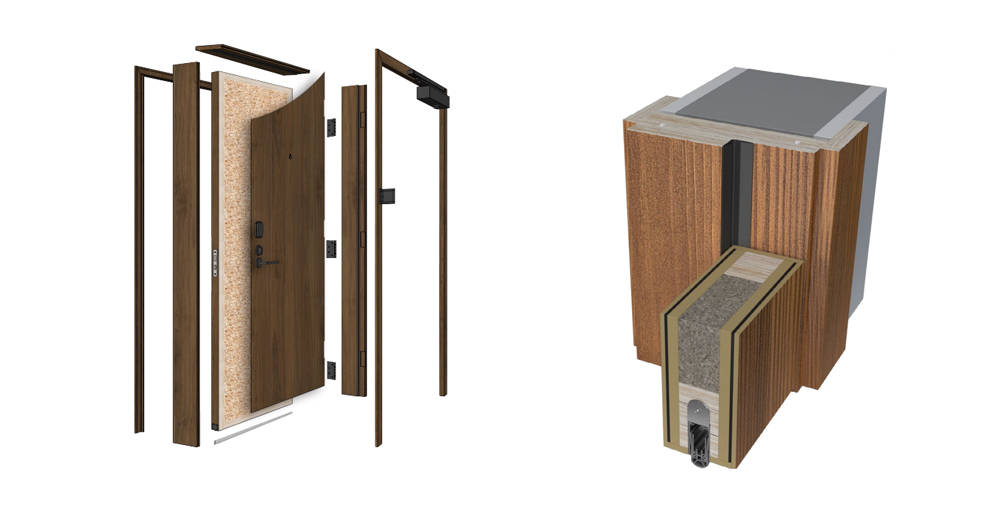
Many contractors learn the hard way that purchasing a door with an STC 40 label doesn’t guarantee STC 40 performance in the field. Acoustic performance is a system-level result. Every component in the assembly must perform:
1. Multi-Layer Acoustic Core
Forest Bright engineers a proprietary multi-layer core that combines mass-loaded materials, decoupled panels, and damping compounds. This combination addresses low, mid, and high-frequency sound simultaneously—unlike single-layer honeycomb cores that create resonant gaps at certain frequencies.
2. Three-Side Compression Seals + Auto Drop Seal
Air gaps around the door perimeter are the single biggest source of acoustic failure in the field. A door with an STC 42 core but inadequate perimeter sealing will underperform a properly sealed STC 35 door. All Forest Bright acoustic doors include triple-compression perimeter gaskets and an automatic bottom drop seal that engages when the door closes and retracts when it opens—eliminating the threshold gap without sacrificing operability.
3. Millimeter-Precision Frame Engineering
The door leaf, frame, and hardware are engineered and tested as a single assembly. This is what allows Forest Bright to publish certified STC ratings from third-party lab testing, not estimates. It’s also what supports WDMA compliance—a key requirement for US commercial projects and hotel brand approvals.
How Leading Hotel Projects Specify Acoustic Doors: Real Examples
CitizenM Los Angeles Downtown — 420 Rooms
Designed by Gensler for one of the world’s most demanding modular hotel brands. Forest Bright supplied all interior wood doors to STC 42 with UL 45-minute fire rating and TPA ULEF-compliant low-formaldehyde materials. The specification met CitizenM’s global acoustic and sustainability standards.
Hilton Garden Inn Kuanzhai Alley, Chengdu — 167 Rooms
A full acoustic door package aligned with Hilton Garden 3.0 brand standards. STC 35 lab-certified (FSTC 30+ on-site verified), with a 30-minute fire rating and customized white oak veneer. Delivered on schedule with full brand compliance documentation.
Gates Foundation Headquarters, Beijing — Office Project
A premium corporate environment requiring floor-to-ceiling acoustic wood doors alongside glass partitions. Forest Bright provided full-cycle delivery: site survey, solution design, fabrication, and precision installation—achieving STC-compliant performance in an open-plan office context.
How to Specify an Acoustic Door for Your Next US Commercial Project
If you’re preparing a door specification for a US hotel, school, healthcare facility, or office building, here’s a simplified decision framework:
Identify your brand or code minimum.
Most US hotel brands publish STC minimums in their brand standards. For independent projects, OSHA and local building codes establish acoustic baselines. Always confirm before specifying.
Add a field buffer of +5 to +7 dB.
Because field performance (FSTC) is 5–7 dB below lab ratings, specify a door rated at least 5 points above your target field performance. If you need FSTC 30 on-site, specify STC 35 in the lab.
Require full assembly test reports.
Request STC test documentation for the complete door assembly—leaf, frame, seals, hardware—not the panel alone. Forest Bright provides certified third-party lab reports for every model in the acoustic series.
Confirm fire-rating and material requirements.
US hotel projects typically require UL-listed fire ratings (20, 45, or 60 minutes) combined with acoustic performance. Forest Bright offers fire ratings up to 60 minutes across the STC 40 and STC 42 models, with ULEF-compliant low-formaldehyde material options for LEED and WELL projects.
Precision Specification Protects Your Project
The gap between STC 30 and STC 42 isn’t just a number on a test report. It’s the difference between a guest who wakes up refreshed and one who leaves a negative review. It’s also the difference between a precise specification that protects your client’s investment and an over-engineered door schedule that quietly absorbs project contingency.
The right acoustic door rating depends on your project type, brand requirements, ambient noise environment, and budget—not on a default specification. Forest Bright’s complete acoustic door series, from FB-STC30 through FB-STC42, is engineered and third-party certified to give US architects and contractors the verified performance data needed to specify with confidence.
Whether you’re working on a 50-room boutique hotel in Austin or a 400-room full-service property in Miami, the acoustic door decision deserves more than a line item—it deserves a system-level solution.
Ready to Specify the Right Acoustic Door?
Forest Bright’s acoustic specialists provide free project consultations, certified test reports, and sample door assemblies for US architects, contractors, and hotel developers. Our team has delivered door packages to CitizenM, Hilton, Marriott, and the Gates Foundation.
