
Table of Contents
Quick Summary: Anti-pinch doors are essential for kindergartens because they eliminate “finger traps” at the hinge side using automated roller curtains and 6mm safety radius edges. These systems mitigate liability for school owners while meeting WDMA Grade 4 durability and UL 10C fire safety standards required for educational architecture.
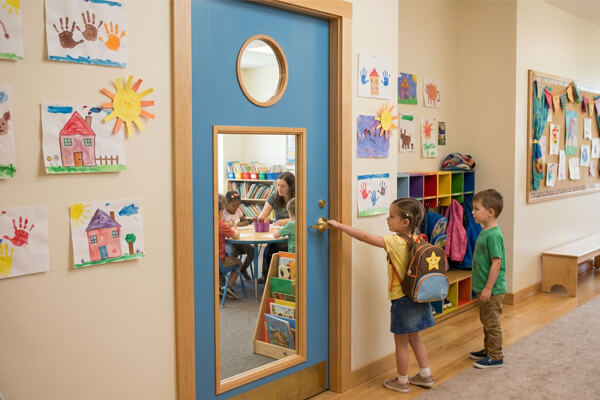
When designing or renovating a kindergarten or elementary school, most architects and facility managers focus on square footage, natural light, and acoustics. Door safety often becomes an afterthought — until a child gets hurt. In North America, finger-pinch injuries from doors account for a significant share of all childhood injuries in school settings. The solution isn’t complicated — but it requires the right product specification from the start.
The Hidden Danger Behind Every Classroom Door
Standard interior doors have sharp 90° frame edges and a closing mechanism that generates significant force. For an adult, a finger caught in a closing door is painful but manageable. For a 4- to 6-year-old child, the same scenario can cause fractures, lacerations, or permanent tissue damage. The hinge side of the door is the highest-risk zone — but the latch side edge, when slammed against a door frame, carries equal danger.
What makes schools uniquely high-risk environments is the combination of factors: dozens of children moving through corridors simultaneously, limited spatial awareness in young children, frequent distraction, and door hardware designed primarily for adult use. Standard commercial door specifications simply are not engineered with kindergarten occupants in mind.
That’s where Forest Bright’s kindergarten-specific door configuration system changes the equation entirely — engineering child safety into every component, from the edge profile to the door core to the frame geometry.
6MM
Max Rounded Edge Radius
42 dB
Sound Insulation Rating
5-Layer
Composite Core Structure
Forest Bright’s Kindergarten Door Safety System: A Full-Stack Approach
Unlike manufacturers who treat “kindergarten doors” as standard commercial doors with a coat of bright paint, Forest Bright has developed a dedicated functional configuration system for educational facilities. Each safety feature is engineered as an integrated system — not an afterthought add-on. Here’s how each component works.
1. Kindergarten-Spec Rounded Edges (GUV-Compliant)
The most fundamental injury-prevention feature begins with the door’s edge geometry. GUV — Germany’s statutory accident insurance institution — recommends that door frames and leaf edges be rounded to eliminate sharp contact points that cause lacerations during impact. Forest Bright engineers this directly into every kindergarten door specification.
Door and frame edges can be rounded with a radius of up to 6MM — what the industry refers to as a “radius edge.” This seemingly small detail makes an enormous difference when a child bumps into a door frame at running speed. Instead of a sharp 90° impact, the rounded profile distributes force and dramatically reduces the risk of cuts.
Forest Bright offers this rounded edge profile across multiple edge systems to match different design requirements:
- PU Edges — High-density polyurethane edging, impact-resistant and seamlessly moldable to any radius profile.
- Plastic Edges — Cost-effective, available in a full color palette to match classroom design schemes.
- Solid Wood Edges — Premium natural wood edging, ideal for Montessori and nature-themed learning environments.
- Concealed Edges — Hidden edge profile for a clean, seamless visual aesthetic where the edge band is invisible from the face.
- SOFTLINE Wood Door Frame — A proprietary Forest Bright frame system where the entire door frame profile is contoured and softened, eliminating the sharpest impact zone — the frame edge.
Specifier Note: When submitting architectural specifications for kindergarten or elementary school projects, Forest Bright’s rounded-edge door system can be referenced under GUV guideline compliance. Our team provides full specification documentation for permit submissions upon request.
2. Automatic Anti-Pinch Roller Blind System
If rounded edges address impact injuries, the anti-pinch roller blind system addresses the most dangerous scenario of all: a child’s fingers caught in the hinge gap as a door swings shut. This is the leading mechanism of severe finger injuries in school environments — and it is entirely preventable.
Forest Bright’s anti-pinch roller blind is an integrated protective curtain installed along the hinge side of the door. The mechanism is elegantly simple and highly effective:
- Automatic Activation: The roller blind deploys automatically as the door begins to open, covering the hinge-side gap throughout the full range of motion.
- Zero Child Interaction Required: The system operates passively — children do not need to interact with it or be aware of it. Protection is constant and automatic.
- Compliant Standards: The system meets applicable school safety standards for finger-protection devices.
- Fire Door Compatible: Critically, the anti-pinch roller blind can be installed on fire-rated doors, making it viable for corridor and exit door applications where fire compliance is mandatory.
- Retrofit-Ready: The system can be retrofitted onto existing installed fire doors, making it an ideal solution for school renovation and upgrade projects — not just new construction.
For architects and facility managers specifying doors for renovations, this retrofit capability is significant. It means schools don’t need to replace entire door assemblies to achieve compliance — the anti-pinch system can be added to the existing fire-door installation during a scheduled maintenance window.
3. 2MM ABS Edge Banding + PUR Edge Technology
A door’s edge is its most vulnerable structural point — the first place to show wear, chipping, moisture ingress, or delamination under the punishment of daily school use. Forest Bright addresses this with a 2MM ABS edge banding system bonded using PUR (polyurethane reactive) adhesive technology.
This combination matters for two distinct reasons:
- 2MM ABS Thickness: At 2MM, the ABS (Acrylonitrile Butadiene Styrene) edge band is substantially thicker than the 0.4–1MM banding used on standard commercial doors. This provides a significantly harder, more impact-resistant surface at the edge — where kindergarten doors take their hardest knocks from chairs, backpacks, and running children.
- PUR Adhesive Bonding: PUR adhesive creates a near-permanent, moisture-resistant chemical bond between the edge band and the door substrate. Unlike standard EVA (hot-melt) adhesive, PUR resists steam, humidity, and cleaning chemicals — critical in school environments where doors are wiped down daily.
The result is an edge that doesn’t chip, peel, or lift — maintaining both its protective geometry and its clean visual appearance across years of heavy use. Schools using PUR-bonded edge banding typically report significantly lower maintenance costs compared to doors with standard edge treatment.
4. Commercial Heavy-Duty Usage Rating
A kindergarten door is opened and closed hundreds of times daily — by children who slam, lean on, kick, and hang from doors in ways no adult specification anticipates. This is why Forest Bright specifies commercial heavy-duty usage ratings for all kindergarten door configurations, not the lighter-duty ratings common in residential or low-traffic commercial applications.
The door interior uses a composite core technology with a 5-layer sandwich structure:
Outer Face Veneer / Surface Layer
High-pressure decorative laminate or wood veneer, abrasion and scratch resistant
MDF / HDF Backing Board
High-density fiberboard providing rigidity and surface stability
Composite Core Layer
Engineered composite core using honeycomb or multi-density fill for structural performance
MDF / HDF Backing Board
Symmetric with Layer 2 for dimensional stability and warp resistance
Opposite Face Veneer / Surface Layer
Matching outer face treatment for balanced door construction
This 5-layer assembly delivers maximum dimensional stability — the door won’t warp, bow, or sag over time — and optimal grip strength for hinge and hardware mounting, ensuring that screws, hinges, and closers remain securely anchored even after years of high-cycle use.
5. Teacher’s Office Door: Privacy, Acoustics, and Clean Design
A kindergarten is not a single-use space. Beyond classrooms, the facility requires administrative and teacher work areas that demand a different performance profile — specifically acoustic privacy combined with visual transparency for supervision.
Forest Bright’s teacher’s office door specification addresses this directly with a tailored configuration:
42 dB
Sound Insulation (RW.P)
Provides effective acoustic separation between teacher office and classroom corridor noise, enabling focused administrative work.
Flat + Transparent
Design Language
Clean, flat-flush door face with optional glazed sidelite panel — enabling line-of-sight supervision while maintaining acoustic privacy.
Block-Style Frame
With Side Panel
Wooden block-style door frame with integrated side panels — structural rigidity meets visual warmth appropriate for an educational setting.
The teacher’s office door completes a cohesive safety and performance system for the entire facility — with child-protection features in corridors and classrooms, and acoustic privacy with a clean architectural language in administrative spaces.
Why Standard Commercial Doors Fall Short in Schools
Many school districts default to standard commercial-grade door specifications when budgeting renovation or new construction. It’s an understandable instinct — commercial doors are familiar, widely available, and typically less expensive at the point of purchase. But this comparison misses several critical factors:
| Feature | Standard Commercial Door | Forest Bright Kindergarten Door |
|---|---|---|
| Edge Geometry | Sharp 90° edges | Up to 6MM radius — GUV compliant |
| Hinge-Side Pinch Protection | None standard | Auto-activate anti-pinch roller blind |
| Edge Banding Thickness | 0.4–1MM (EVA bonded) | 2MM ABS + PUR bonding |
| Core Construction | Single or dual-layer | 5-layer composite core |
| Fire Door Compatible Pinch Guard | Rarely available | Yes — retrofit compatible |
| Sound Insulation | 28–35 dB typical | Up to 42 dB (RW.P) |
| Usage Rating | Standard commercial | Heavy-duty commercial |
What to Look for When Specifying Kindergarten Doors
If you’re an architect, school facility director, or purchasing officer, use this checklist when evaluating door suppliers for kindergarten and elementary school projects:
GUV-Compliant Rounded Edges
Confirm the supplier can achieve edge radii of 4–6MM across the full door and frame assembly, not just the door leaf.
Hinge-Side Pinch Guard System
Insist on an automatic (not manual) pinch-guard system that activates without child interaction. Verify fire-door compatibility.
2MM+ Edge Banding with PUR Adhesive
Thinner edge banding delaminated by humidity is a leading cause of sharp exposed-substrate edges. Specify 2MM ABS minimum with PUR bonding.
Heavy-Duty Usage Classification
Request the usage classification documentation. School corridor doors should be specified at commercial heavy-duty ratings, not standard interior commercial.
Acoustic Performance Documentation
For teacher offices and administrative areas, request certified RW.P (weighted sound reduction index) test data — not manufacturer estimates.
Warranty and After-Sales Support
A kindergarten door installation is a long-term infrastructure decision. Choose a manufacturer with dedicated project support and documented warranty terms for educational facilities.
Frequently Asked Questions
What is an anti-pinch door system for kindergartens?
+
Are Forest Bright anti-pinch doors compatible with fire door standards?
+
What rounded edge radius is recommended for kindergarten doors?
+
What sound insulation level do Forest Bright school doors provide?
+
Can the anti-pinch roller blind be added to doors already installed?
+
Does Forest Bright supply doors to school projects across North America?
+
Conclusion: The Right Door Protects More Than a Building
Kindergartens and elementary schools are not ordinary commercial buildings. They are places where children develop, play, learn, and sometimes get hurt in entirely preventable ways. Door systems are one of the highest-contact, highest-risk building components in any school — and most school door specifications have not caught up with that reality.
Forest Bright’s kindergarten door safety system — GUV-compliant rounded edges, automatic anti-pinch roller blinds, 2MM ABS + PUR edge banding, 5-layer heavy-duty core construction, and 42dB acoustic performance for teacher offices — represents the most comprehensive child-safety door specification available for North American educational facilities.
Specifying the right door isn’t a luxury decision. It’s a duty-of-care decision. And it costs far less than the consequences of getting it wrong.
Ready to Specify Forest Bright for Your
Kindergarten or School Project?
Our project team provides product specifications, compliance documentation, and custom configuration support for educational facility projects worldwide.
