
Table of Contents
- What Is the Difference Between Mineral Core and Particleboard Core Doors?
- How Fire-Rated Is a Particleboard Core Door?
- How Fire-Rated Is a Mineral Core Door?
- Which Core Offers Better Acoustic (STC) Performance?
- What Are the Size and Thickness Limits for Each Core Type?
- Which Core Should You Specify for Hotels, Healthcare, Schools, and Offices?
- How Are Forest Bright Doors Tested and Certified?
- Frequently Asked Questions
The core is the single biggest factor separating a 20-minute particleboard door from a 90-minute mineral core door. Both are legitimate fire-rated constructions in Forest Bright’s flush door line — the right choice depends on the fire rating your code official requires, the STC target on your acoustic schedule, and the door size on your elevation drawings. This guide compares the two on the specifics that show up in a submittal review.
20 min
Particleboard core, max UL 10C rating
90 min
Mineral core, max UL 10C rating
STC 30-32
Particleboard core acoustic rating
STC 35
Mineral core acoustic rating
What Is the Difference Between Mineral Core and Particleboard Core Doors?
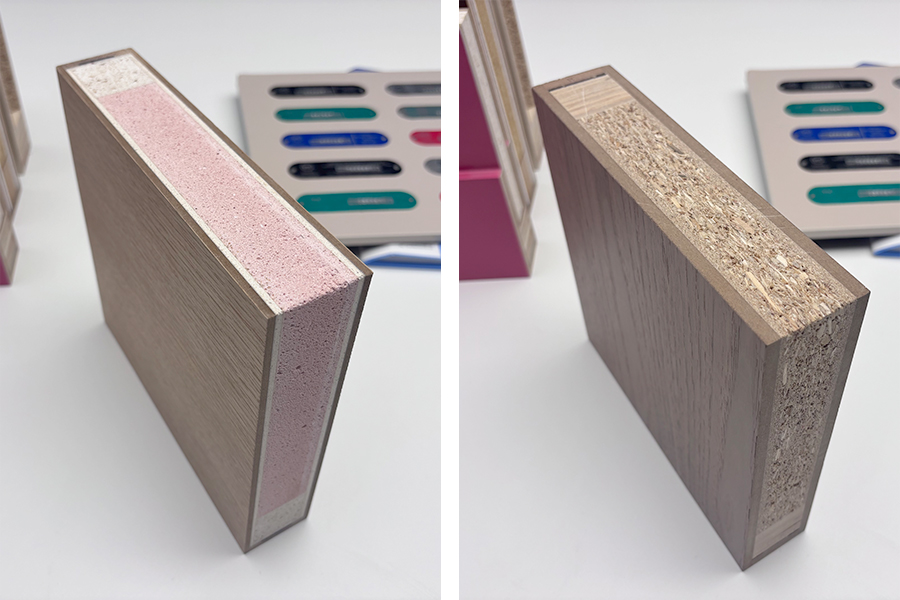
The difference is the fill material inside the LVL stile-and-rail frame, and that fill material determines how long the door can hold a fire rating and how much sound it blocks. Particleboard core uses a compressed wood-particle fill bonded between HDF crossbanding, sized within a standard 1-3/8″ LVL stile and rail frame. Mineral core replaces that fill with an incombustible mineral composite and steps up to a heavier 2-1/8″ mineral composite stile and rail, which is what allows the higher fire ratings.
| Specification | Particleboard Core | Mineral Core |
| Positive-pressure fire rating | 20 minutes | 45, 60, or 90 minutes |
| Acoustic rating (STC) | 30-32 | 35 |
| Door thickness | 1-3/4″ | 1-3/4″ |
| Stiles & rails | 1-3/8″ LVL | 2-1/8″ mineral composite |
| Max single door size | 4′ x 9′ | 4′ x 8′ |
| Max double (pair) size | 8′ x 9′ | 8′ x 8′ |
Source: Forest Bright Flush Wood Door 2026 catalog, core construction and specification tables.
How Fire-Rated Is a Particleboard Core Door?
Particleboard core flush doors are rated for 20-minute positive-pressure fire protection. That rating is achieved with a 3-ply bonded construction for paint-grade doors, or 5-ply construction for veneer and HPDL faces, and it’s tested to UL 10C, NFPA 252 (2012), and UBC 7-2, with third-party certification by Intertek Warnock Hersey (ITS-WH). This tier covers the large majority of interior openings that require a rating but aren’t on a corridor or stair enclosure where code demands more.
How Fire-Rated Is a Mineral Core Door?
Mineral core flush doors extend to 45-, 60-, and 90-minute positive-pressure fire ratings, tested under the same UL 10C, NFPA 252 (2012), and UBC 7-2 standards and certified by Intertek Warnock Hersey (ITS-WH). The incombustible mineral composite fill, paired with the heavier 2-1/8″ mineral composite stile and rail, is what carries the door past the 20-minute ceiling of a standard particleboard core. This is the core to specify for stairwell doors, corridor doors in higher-hazard occupancies, and any opening where the life safety drawings call out 45 minutes or higher.
Which Core Offers Better Acoustic (STC) Performance?
Mineral core outperforms particleboard core acoustically, testing at STC 35 versus STC 30-32 for particleboard, per ASTM E90 and E413 laboratory testing. That 3-5 point difference matters for hospitality projects specifically: Hilton’s dual acoustic acceptance standard requires a laboratory STC of 35 or higher and a field FSTC of 30 or higher for guest room entry doors. A particleboard core door at STC 30-32 can fall short of that lab threshold, while mineral core clears it. If your project needs higher acoustic performance than either core provides on its own — up to STC 42-45 — Forest Bright’s composite sound core and multi-layer composite core options are built specifically for that range and are worth a separate conversation with your Forest Bright representative.
What Are the Size and Thickness Limits for Each Core Type?
Both core types are manufactured at a standard 1-3/4″ thickness, but maximum door size shrinks as the core gets denser and heavier. Particleboard core doors go up to 4′ x 9′ single and 8′ x 9′ double. Mineral core doors are capped at 4′ x 8′ single and 8′ x 8′ double — a smaller ceiling driven by the weight and structural handling limits of the mineral composite fill and its heavier stile-and-rail frame. If your elevation calls for an oversized opening above 4′ x 8′, confirm the fire rating requirement against the core options early, since the highest fire ratings and the largest door sizes don’t come from the same core.
Choose Particleboard Core When
✓ Code requires 20-minute rating or less
✓ Opening exceeds 4′ x 8′ (up to 4′ x 9′)
✓ STC 30-32 satisfies the acoustic schedule
✓ General interior or mainstream commercial doors
Choose Mineral Core When
✓ Code requires 45-, 60-, or 90-minute rating
✓ Opening fits within 4′ x 8′ single / 8′ x 8′ pair
✓ Project must meet Hilton’s STC ≥ 35 lab standard
✓ Healthcare spaces or higher-hazard corridors
Which Core Should You Specify for Hotels, Healthcare, Schools, and Offices?
Forest Bright’s product literature ties each core to a typical application, and that guidance lines up with what shows up on most commercial door schedules:
Hotel guest room entries
Mineral core, where the project targets Hilton’s STC ≥ 35 lab acceptance standard and a 45- or 60-minute corridor rating.
Healthcare patient rooms
Mineral core — listed directly in Forest Bright’s core options as the recommended choice for fire-rated doors and healthcare spaces.
Education / classroom interiors
Particleboard core for standard classroom doors with a 20-minute rating; step up to mineral core for corridor and stair doors requiring higher ratings.
Office interior doors
Particleboard core covers most general office and mainstream commercial openings where a 20-minute rating is sufficient.

How Are Forest Bright Doors Tested and Certified?
Both core types are manufactured to the same underlying quality system, so the difference between them is performance, not process. Every Forest Bright fire-rated door is tested to UL 10C, NFPA 252 (2012), and UBC 7-2, and certified by third-party agency Intertek Warnock Hersey (ITS-WH). Production is managed under ISO 9001 quality management, and Forest Bright’s solid-core doors are tested to the WDMA TM-7 standard for 1,000,000-cycle endurance, meeting Extra Heavy Duty under ANSI/WDMA I.S. 1A-13. Doors are compliant with CARB Phase 2 / TSCA Title VI formaldehyde emission requirements, and every Forest Bright wood door — regardless of core — carries a limited three-year warranty against workmanship and material defects.
Frequently Asked Questions
What is the maximum fire rating for a particleboard core door?
Forest Bright particleboard core flush doors are rated for 20-minute positive-pressure fire protection, tested to UL 10C, NFPA 252 (2012), and UBC 7-2, and third-party certified by Intertek Warnock Hersey (ITS-WH).
What is the maximum fire rating for a mineral core door?
Mineral core flush doors are rated for 45-, 60-, and 90-minute positive-pressure fire protection, tested to UL 10C, NFPA 252 (2012), and UBC 7-2, and third-party certified by Intertek Warnock Hersey (ITS-WH).
How does STC performance differ between particleboard core and mineral core doors?
Particleboard core doors test at STC 30-32. Mineral core doors test at STC 35, which meets Hilton’s laboratory acoustic acceptance standard of STC 35 or higher for guest room entry doors.
Are mineral core and particleboard core doors available in the same sizes?
No. Particleboard core doors are available up to 4 feet by 9 feet single and 8 feet by 9 feet double. Mineral core doors are available up to 4 feet by 8 feet single and 8 feet by 8 feet double, a smaller maximum size range tied to the density and weight of the mineral core material.
Which core type should I specify for a healthcare project?
Forest Bright’s product literature lists mineral composite core as the recommended option for fire-rated doors and healthcare spaces, based on its superior fire performance relative to particleboard core.
Do both core types carry the same warranty?
Yes. All Forest Bright wood doors, regardless of core type, are backed by a limited three-year warranty against workmanship and material defects.
Not Sure Which Core Fits Your Door Schedule?
Send Forest Bright your fire rating and STC requirements, and we’ll confirm the right core, size limits, and lead time for your project.
