
Table of Contents
In today’s fiercely competitive North American hotel market, guest satisfaction is decided by factors that rarely appear on a marketing brochure. Noise — corridor traffic, HVAC rumble, adjacent room conversation, elevator mechanics — consistently ranks among the top three causes of negative online reviews across every hotel segment from select-service to luxury. A single recurring noise complaint on Google or TripAdvisor can suppress booking rates, erode RevPAR, and trigger costly renovations that could have been avoided at the specification stage.
The guest room door is your most powerful and most underutilized acoustic tool. A correctly specified hotel acoustic door — engineered with the right Sound Transmission Class (STC) rating, verified perimeter sealing, fire-rated assembly, and durable finish — can reduce corridor-to-room noise transmission by 60% or more compared to a standard hollow-core door. The cost difference at the unit level is far smaller than the lifetime value of a quieter, higher-rated guest experience.
Understanding STC Ratings: The Non-Negotiable Starting Point
Sound Transmission Class (STC) is the ASTM E90 / E413 standard metric for measuring how much airborne sound a door assembly blocks. It is the universal language of acoustic specification — and the number that hotel brand standards, architects, and building inspectors all reference first. Understanding what the numbers mean in real hotel conditions is essential before any product comparison.
STC Performance Reference: Hotel Applications
| STC Rating | Performance Tier | Typical Application | What a Guest Hears |
|---|---|---|---|
| STC 28–30 | Basic | Economy motels, hollow-core standard | Loud speech clearly audible |
| STC 30–32 | Standard | Mid-scale, select-service hotels | Speech audible but not distinct |
| STC 22–35 | High Performance | Full-service, upscale (Marriott, Hilton brand minimums) | Faint murmur only |
| STC 35–42 | Premium / Luxury | Luxury resorts, casino hotels, executive suites | Near-silence; corridor undetectable |
Most major US hotel brands — Marriott International, Hilton Hotels & Resorts, and IHG — specify a minimum STC 32 in their design and construction standards for all guest room corridor entry doors. Properties positioned near entertainment floors, elevator banks, or high-traffic vending alcoves should target STC 32–35 as a project baseline, with luxury flagships moving to STC 40+.
⚠ Critical Industry Note: An STC rating is only valid as a complete tested assembly — door slab, frame, hardware, threshold, and perimeter seals — tested together in an NVLAP-accredited laboratory. A high-STC slab paired with an improperly sealed frame can perform 10–15 points below its rated value under real-world field conditions.
What Sets Hotel Acoustic Door Specialists Apart
Not all solid-core doors deliver meaningful acoustic performance. The gap between a standard solid-core and a precision-engineered acoustic assembly is substantial — and entirely invisible to the eye. Here are the three engineering dimensions that define genuine acoustic door specialists:
1. Engineered Core Construction
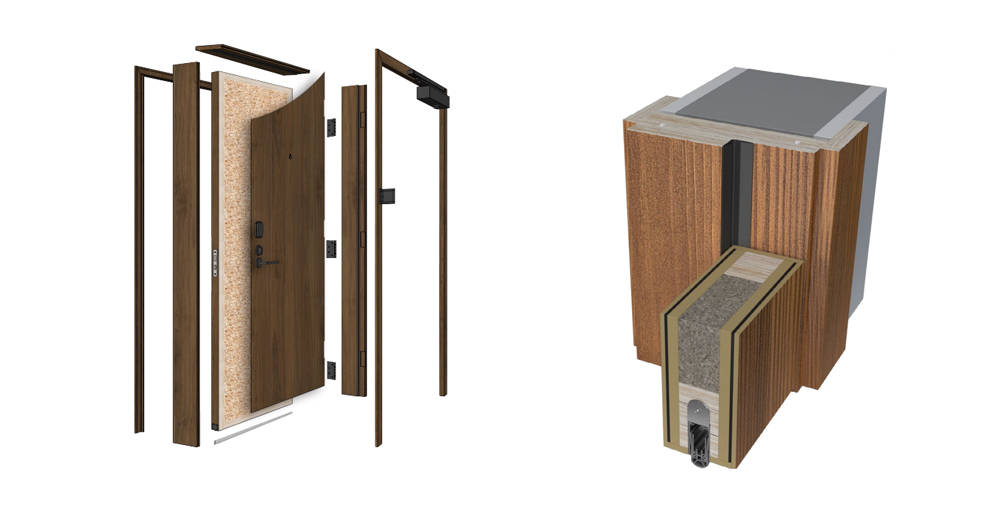
Achieving STC 42+ requires more than mass alone. Leading acoustic hotel doors use layered, engineered core strategies:
- Multi-layer composite cores: Alternating layers of high-density fiberboard (HDF), mineral wool batt, and viscoelastic damping compounds interrupt sound wave transmission and dissipate energy as heat rather than allowing it to radiate through the face panel.
- Mass-loaded construction: Premium acoustic doors in the STC 35–42 range often weigh 90–130 lbs for a standard 3’×7′ unit. This mass is the primary barrier against low-frequency noise — HVAC rumble, bass from entertainment floors, elevator machinery — that lighter doors simply cannot block.
- Decoupled face panels: In the highest-performing assemblies, the decorative veneer or laminate face is mechanically isolated from the structural core using damping washers or floating attachment systems, preventing vibration-induced sound radiation from the door face itself.
2. Perimeter Sealing Systems — The Most Overlooked Factor
The air gap between the door slab and its frame is responsible for more acoustic failures in hotel installations than any other single factor. A door with a 1/8″ gap at the bottom loses 8–12 STC points in real-world performance, regardless of the slab’s rated value. Industry-standard sealing components include:
- Automatic door bottoms (ADB): Drop-seal mechanisms that retract during the door’s swing arc and compress firmly against the threshold upon closure. These are non-negotiable for achieving rated STC performance — and should be specified by model number, not generic description, to ensure UL listing compatibility.
- Compression bulb jamb and head seals: Neoprene or silicone compression seals applied to all three perimeter sides that compress under door-closing pressure, eliminating the clearance gaps required for standard door operation. Properly selected seals add minimal closing force while delivering substantial acoustic improvement.
- Acoustic astragals for double-leaf doors: Suite entry doors, interconnecting room pairs, and ballroom or meeting room partitions require acoustic astragals — seal strips on the meeting stile of the active leaf — to close the most acoustically vulnerable gap in double-door configurations.
3. Simultaneous Fire Rating and Acoustic Performance
Under the International Building Code (IBC) and NFPA 101 Life Safety Code, virtually all guest room corridor entry doors in US hotels must carry a minimum 20-minute fire assembly rating. Stairwells, elevator lobbies, and certain means-of-egress corridors require 45- or 90-minute ratings. The critical specification challenge is achieving both fire compliance and acoustic performance simultaneously — a distinction that separates true acoustic specialists from standard commercial door suppliers who offer fire-rated or acoustic products but rarely both in the same certified assembly. Every Forest Bright hotel door is engineered and laboratory-tested to achieve UL fire listing and NVLAP STC certification as a single, unified assembly.
Emerging Trends: Sustainability, Aesthetics, and Smart Integration
Sustainability & LEED Documentation
Hotel developers pursuing LEED v4 BD+C or LEED for Hospitality certification increasingly specify doors with FSC Chain-of-Custody certified wood veneers, CARB Phase 2 compliant composite cores, low-VOC adhesives, and formaldehyde-free manufacturing. Beyond certification credits, hotel brands including Marriott (Serve360), Hilton (Travel with Purpose), and IHG (Journey to Tomorrow) now include sustainable procurement requirements in their design standards, making EPD (Environmental Product Declaration) and HPD (Health Product Declaration) documentation a market expectation rather than a bonus. Forest Bright provides full sustainability documentation packages — FSC, CARB, EPD, HPD — with every acoustic door specification submittal.
Design Aesthetics: Performance Without Visual Compromise
The historic trade-off between acoustic performance and visual design — where high-STC doors looked industrial and institutional — has been eliminated by advances in face construction. Today’s hotel acoustic doors are fully specifiable in:
- Premium rotary-cut or rift-cut wood veneers — walnut, white oak, maple, cherry, white ash — for full-service and luxury hotel interiors
- Textured high-pressure laminate (HPL) faces — in hundreds of patterns, stone and textile simulations, and solid colors for select-service and extended-stay brands seeking durability in high-traffic corridors
- Shop-applied factory paint finishes — spray-applied, sanded-smooth, in brand-matched custom colors with MDF faces for premium painted-door aesthetics
- Stile-and-rail panel profiles — increasingly specified by lifestyle hotel brands (Autograph Collection, Curio, Graduate Hotels, Ace Hotel) seeking residential warmth in guest room interiors
Hotel Acoustic Door Specification: A Buyer’s Checklist
Use this checklist during design development and procurement to ensure your hotel door specification delivers on acoustic performance, code compliance, brand standards, and long-term operational durability:
01
Require a tested assembly report — not just a door slab STC rating. Request the NVLAP laboratory test certificate for the complete door + frame + hardware + seals assembly you are actually purchasing.
02
Verify your hotel brand’s minimum STC standard and add a 3–5 point buffer above it to account for field installation variability and future acoustic performance degradation.
03
Specify automatic door bottoms and compression perimeter seals by model number — these are not optional accessories but structural components of the acoustic rating. Confirm their inclusion in the contract documents, not just the shop drawings.
04
Confirm combined fire + acoustic certification — ensure the assembly carries simultaneous UL or Intertek fire listing (20-, 45-, or 90-minute as required) and NVLAP acoustic certification as a single labeled product.
05
Build lead time into your schedule during design development — custom acoustic hotel door assemblies average 8–12 weeks from confirmed purchase order to delivery; smart-integrated assemblies may run 10–14 weeks. Late-stage door procurement is one of the most common causes of hotel opening delays.
06
Request full sustainability documentation — FSC chain-of-custody, CARB Phase 2 compliance, EPD, and HPD — as a standard submittal requirement, even if LEED certification is not currently planned. Brand ownership and ESG reporting requirements frequently change post-opening.
07
Address interconnecting room and suite entry doors separately — double-leaf acoustic configurations require independent assembly testing, acoustic astragals, and coordinator hardware not covered by single-door STC ratings.
Quiet Rooms Build Loyal Guests — Start at the Door
In an environment where online review platforms directly influence RevPAR, OTA rankings, and group booking decisions, acoustic comfort has become a baseline guest expectation — not a premium amenity. The guest room door is the most cost-effective acoustic investment a hotel developer or renovation team can make: it is specified once, installed once, and delivers its performance — or its failure — to every guest, on every night, for the life of the property.
Specifying correctly means understanding STC ratings as complete tested assemblies, treating perimeter seals as non-negotiable components rather than accessories, requiring simultaneous fire and acoustic certification, and partnering with a manufacturer who can deliver design flexibility alongside certified performance. The North American architectural door market offers a range of capable suppliers — but the combination of tested acoustic performance, fire-rated compliance, premium customization, sustainable documentation, and hotel-sector procurement expertise in a single source remains a meaningful differentiator.
At Forest Bright, we engineer architectural wood doors built specifically for the demands of the North American hospitality market — combining NVLAP-certified acoustic performance from STC 30 through STC 42, UL fire-rated assembly listings, premium wood veneer and HPL customization, FSC and CARB compliance documentation, and a direct specification support team that works with architects, interior designers, general contractors, and hotel procurement managers from concept through delivery.
Ready to Specify?
Get Certified STC Data, Finish Samples & a Project Quote from Forest Bright
Our architectural door specialists work directly with hotel architects, interior designers, and procurement teams — from schematic design through submittal approval and delivery.
Request a Custom Project Quote →
Response within 1 business day · No-obligation specification consultation · Samples available
