

Table of Contents
In hotel design, doors are the first physical touchpoint a guest has with a property — before they see the room, before they feel the bed, they interact with the door. Yet in most project specifications, architectural wood doors receive far less attention than flooring, millwork, or fixtures. That oversight is expensive. Misspecified doors are among the top five reasons for on-site rework delays in hospitality construction, adding unplanned cost and schedule risk that no owner, architect, or general contractor can afford.
Whether you’re developing a 50-room boutique property, renovating a full-service urban hotel, or managing a multi-property portfolio refresh, the decisions you make on custom wood door specifications will directly affect guest satisfaction scores, maintenance intervals, brand consistency, and — critically — your project’s bottom line. This guide breaks down what every stakeholder needs to know before a single purchase order is issued.
Why Hotel Door Specification Deserves More Attention
The hospitality sector is one of the most demanding environments for any building component. Hotel guest room doors typically cycle through 20 to 40 open-and-close operations per day — a number that translates to roughly 7,000 to 14,000 cycles annually. Over a standard renovation interval of 8 to 12 years, that door must perform reliably tens of thousands of times, under varying humidity conditions, with inconsistent user behavior, and without the maintenance attention a residential door would receive.
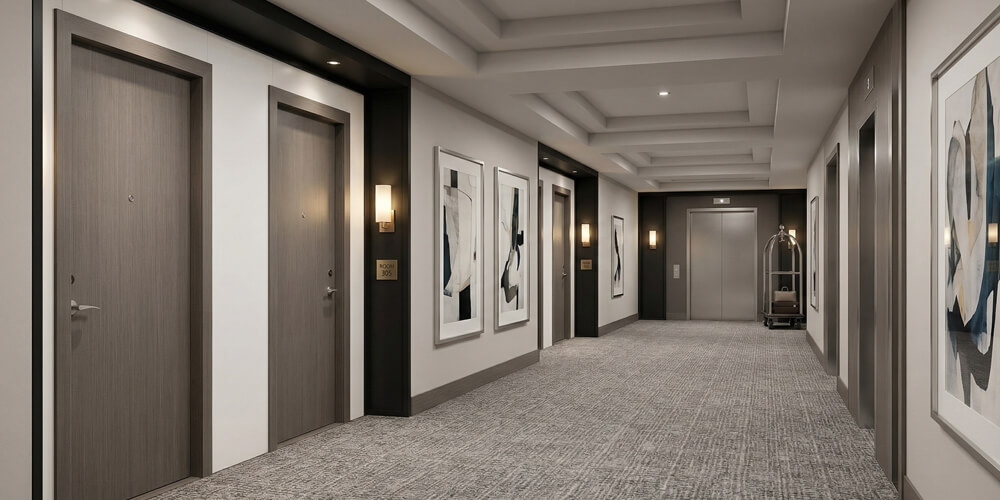
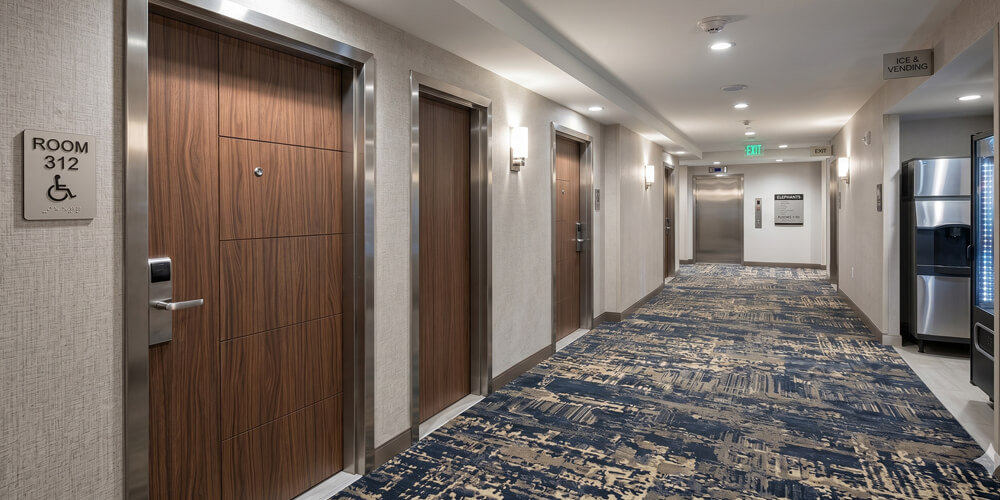
Beyond durability, doors carry heavy aesthetic responsibility. They define corridor rhythm, signal brand standards, and anchor the transition between public and private space. In upper-upscale and luxury segments, mismatched door stains or hardware prep errors are immediately visible to design-conscious guests — and equally visible in the brand’s online reviews.
There is also a compliance dimension. Hotel guest room entrance doors and corridor doors are heavily regulated under the International Building Code (IBC), NFPA 80, and ADA requirements. Getting fire ratings, door hardware prep, and threshold clearances wrong doesn’t just cost money — it creates liability and can delay a Certificate of Occupancy.
Core Specifications Every Project Team Must Align On
Successful custom hotel door projects start with alignment — between the owner’s program, the architect’s design intent, and the GC’s procurement and installation sequence. The following four specification categories are where misalignment most commonly occurs.
1. Door Construction and Core Type
For hotel applications, solid stave core (SSC) construction is the industry benchmark. A solid stave core uses parallel wood blocks bonded under pressure, delivering superior screw-holding strength for heavy-duty hinges and commercial locksets, excellent acoustic performance (critical in high-density corridors), and dimensional stability across seasonal humidity swings. Expect solid stave core doors to run 15–25% higher than hollow metal or particleboard-core alternatives — a differential that pays back in reduced maintenance costs within the first renovation cycle.
Mineral core options are required for fire-rated assemblies (typically 20-minute, 45-minute, or 90-minute ratings depending on occupancy classification and corridor configuration). Owners and architects should confirm fire-rating requirements with the project’s AHJ (Authority Having Jurisdiction) before finalizing door schedules — this is not a detail that can be retrofitted after fabrication.
2. Fire Rating and Code Compliance
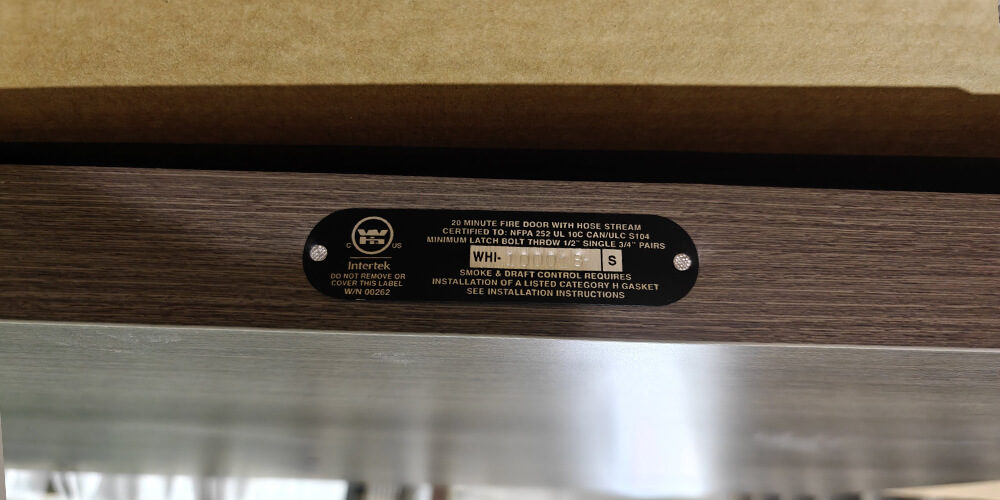
Most US hotels classify corridor-to-guestroom openings as requiring a minimum 20-minute fire-rated assembly under IBC Chapter 7 and NFPA 80. However, high-rise properties, mixed-use developments, and buildings with specific occupancy combinations may require 45-minute or higher-rated assemblies. The door, frame, and hardware must all be listed as a tested assembly — specifying a rated door with an unrated frame is a code violation regardless of the individual product listings.
Request UL certification documentation and ensure the manufacturer’s label is factory-applied — field-applied labels are not accepted in most jurisdictions. GCs should confirm this during submittal review, not at rough inspection.
3. Hardware Prep and Hinge Specification
Custom wood doors for hotels must be factory-prepped for the hardware schedule — not field-modified. Factory preparation includes hinge cutouts (typically 4.5″ × 4.5″ for commercial duty), lockset bore and strike reinforcement, door viewer, and auto-closer reinforcement if required. Field boring of lock preps on solid stave core doors frequently compromises the veneer face and creates structural weak points that void manufacturer warranties.
The hardware schedule must be finalized and submitted to the door manufacturer before production begins — not after. On multi-hundred-room hotel projects, a mid-production hardware change can cascade into a 2–4 week delay and significant rework charges. Architects should issue the hardware schedule in the 90% design development phase, and GCs should verify it against the door schedule before releasing the door order.
Finish, Veneer, and Aesthetic Coordination
Wood Species and Veneer Matching
The most common aesthetic failure on hotel door packages is veneer inconsistency across a floor or property. Natural wood veneers — including white oak, walnut, maple, and cherry — exhibit natural variation in grain pattern, figure, and color. Without a proactive veneer-matching strategy, a 200-room hotel could receive doors with noticeable tonal and grain differences across the same corridor run.
Work with manufacturers who offer sequence-matched or book-matched veneer flitches reserved specifically for your project. This requires planning: veneer reservation typically needs to happen 8–12 weeks ahead of production, and some premium species (quarter-sawn white oak, figured walnut, FSC-certified teak) may require longer sourcing lead times. For brand-critical projects, request veneer samples from the actual lot reserved for the job — not generic species samples from the manufacturer’s library.
Factory-Applied Finishes vs. Field Finishing
For hotel projects, factory-applied pre-finished doors are strongly preferred over field-finished stock. Factory finishing is applied in a controlled environment using UV-cured or conversion varnish systems, delivering consistent color, sheen level, and mil thickness across every door in the package. Field finishing, even by skilled applicators, introduces variables — ambient humidity, lap marks, inconsistent stain absorption — that are especially visible under the directional lighting typical of hotel corridors.
Specify the finish by sheen (matte, satin, semi-gloss), stain or clear coat, and topcoat system in the door schedule. For properties with aggressive housekeeping protocols — wiping with chemical cleaners, high-frequency contact cleaning — specify a commercial-grade catalyzed topcoat rather than a standard nitrocellulose lacquer.
Lead Times, MOQs, and Supply Chain Reality
Custom architectural wood doors for hotel projects are not shelf-stock items. From approved shop drawings and confirmed hardware schedule to delivery on site, custom door lead times average 8–12 weeks for standard custom work, and 14–18 weeks for premium species, complex glazing, carved panel profiles, or large-format oversize doors. Supply chain disruptions — which have remained elevated since 2020 — can extend these windows further, particularly for imported hardware or FSC-certified exotic species.
General contractors should work backward from the scheduled door installation window and place orders no later than the steel framing phase, coordinating the door frame rough-in dimensions with the manufacturer’s tolerances simultaneously. Late door orders are one of the leading causes of hotel opening delays in the post-COVID construction environment.
Minimum order quantities (MOQs) vary significantly by manufacturer. Some suppliers require a project minimum of 50 or more doors to offer fully custom production runs; others will accommodate smaller boutique property orders with a premium unit cost. Clarify MOQ requirements during manufacturer qualification — not at bid submission.
How to Select the Right Custom Door Manufacturer
Not all door manufacturers are equipped for the complexity of hotel projects. The following criteria separate qualified partners from suppliers who can fill a standard commercial door order but struggle with hospitality-scale custom work.
Manufacturer Qualification Checklist
- UL and WDMA certification — Verified tested assembly listings, not just door listing alone
- Hotel reference projects — Ask for at least 3 comparable hospitality projects with verifiable contacts
- In-house finishing capability — Factory finishing in a controlled spray environment, not outsourced
- Dedicated project manager — A single point of contact who tracks submittals, samples, and production milestones
- Veneer inventory and matching — Ability to reserve and sequence-match veneers per project
- Shop drawing turnaround — Typically 5–10 business days; faster on repeat project types
- Warranty terms — Minimum 1-year structural warranty; leading manufacturers offer 3–5 years on finish and delamination
Pricing transparency is also a key qualifier. A reputable manufacturer should be able to provide itemized pricing that separates base door construction, factory prep, finishing, and packaging. Lump-sum quotes make it difficult to identify cost-optimization opportunities and create disputes when scope changes arise mid-project.
Specifying for Success: A Summary Checklist
Custom hotel wood doors are a long-term investment, not a commodity line item. When specified correctly, they deliver decade-plus performance, brand-consistent aesthetics, and measurable guest satisfaction returns. When misspecified, they generate callbacks, rework costs, and reputational risk. The following summary captures the key actions for each stakeholder group.
For Hotel Owners
- Budget for solid stave core construction
- Include door package in brand standards
- Require 3-year finish warranty minimum
- Plan door orders into early pre-construction
For Architects
- Issue hardware schedule at 90% DD
- Specify veneer matching strategy
- Confirm fire-rating assembly with AHJ
- Request sample approval from production lot
For General Contractors
- Order 10–12 weeks before install window
- Verify hardware schedule before release
- Inspect UL labels on delivery
- Coordinate frame rough-in with door tolerances
At Forest Bright, we work with hotel owners, leading hospitality architects, and national GCs to deliver custom architectural wood door packages that meet brand standards, code requirements, and project timelines — without the specification gaps that drive change orders. Our team provides shop drawings, veneer samples from the production lot, and a dedicated project manager on every hotel engagement.
Ready to Specify?
Get a Custom Hotel Door Quote from Forest Bright
Share your door schedule or project brief and our specification team will respond within one business day with pricing, lead time, and veneer options.
