
Table of Contents
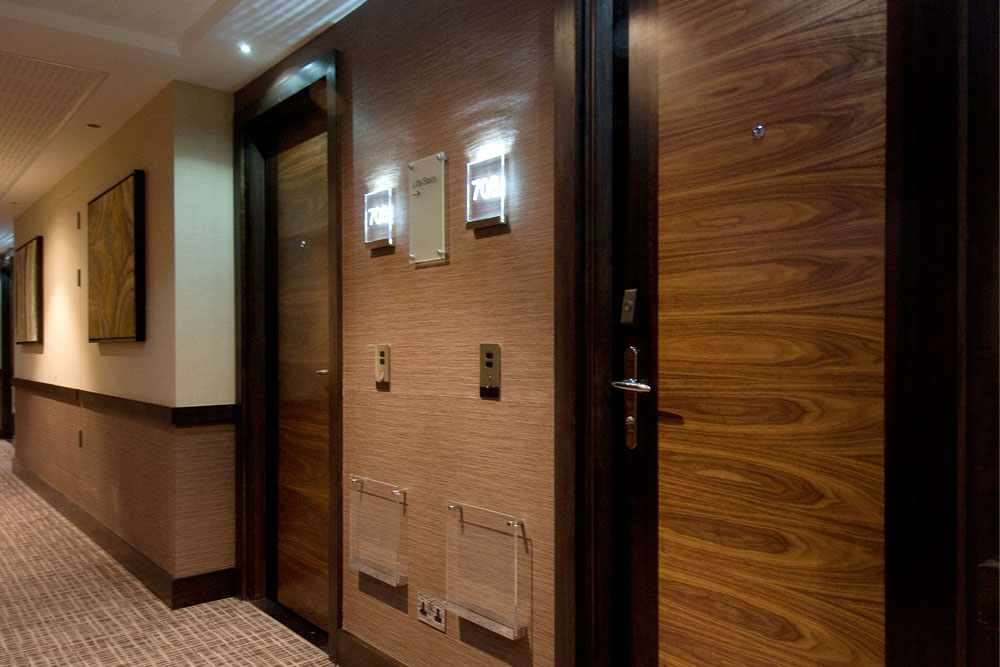
A single hotel renovation can call for 300, 500, even nearly 1,000 guest-room doors. Every one of them needs to read as the same stain color under the same hallway lighting — on day one and five years later. The doors themselves rarely fail. What fails is the spec: vague veneer language, no factory finish requirement, and no sample approval step before production starts.
Why Does Stain Color Vary From Door to Door in a Large Hotel Order?
Visible mismatch in a corridor almost always traces back to one of three points in the process, not a single bad batch:
What Veneer Grade Should Be Specified to Control Stain Consistency?
Forest Bright stain-grade flush and stile & rail doors are produced with WDMA A grade or AA grade veneer, with cut and species specified per project. The grade designation governs the uniformity tolerance of the face veneer going into production — the higher the grade, the tighter the color and grain consistency between leaves cut from the same lot. For a large hotel corridor run, specifying the veneer grade explicitly — rather than leaving it to “manufacturer’s standard” — is the single highest-leverage line item in the spec.
On the surface side, Forest Bright doors also use a veneer-matching face edge as standard (hardwood edge available on request), so the edge band reads as part of the same continuous grain rather than a visible seam at the door’s leading edge.
How Does Reconstituted Veneer Help Match Color Across Hundreds of Doors?
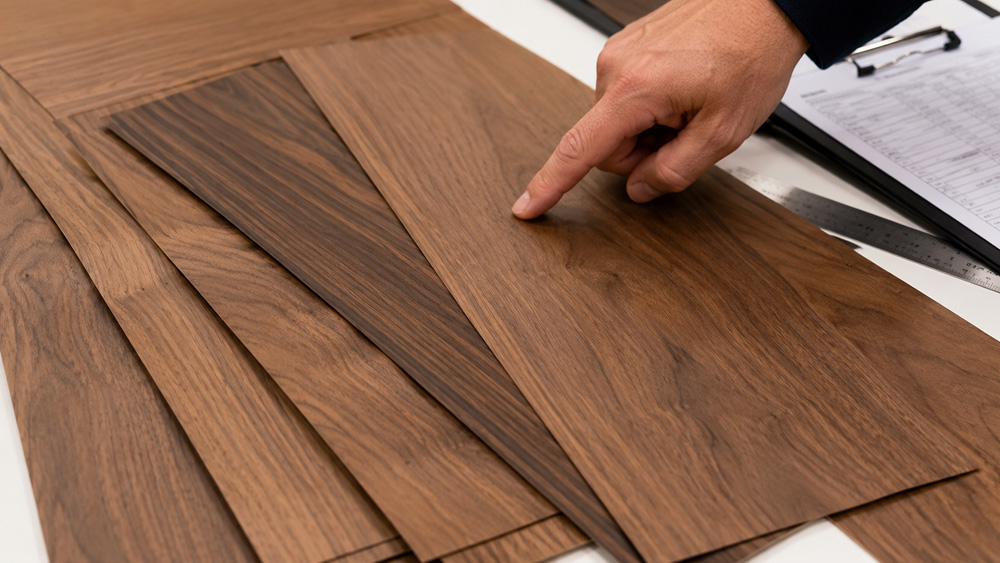
Where a project needs hundreds of doors to look identical — rather than showcase the natural character of solid wood — reconstituted veneer is the more reliable choice. Forest Bright’s flush and stile & rail door lines offer both natural veneer and reconstituted veneer matching options, engineered to repeat the same grain pattern and tone across a production run far more predictably than veneer cut from natural flitches. The face is also available as a sketch face — a single-ply veneer cut and arranged in a defined pattern — specifically to control how grain and character read when door segments are placed side by side, which is exactly the condition a guest-room corridor creates.
What Standard Stain Colors Are Available, and Can They Be Customized?
Forest Bright offers ten standard stain colors as a starting point for project palettes, with custom paint or stain color matching available through your sales representative for brand-specific finishes.
| Standard Stain Option | Tone Family |
|---|---|
| Natural Oak | Light, warm |
| Black Oak | Deep, dark |
| Walnut Oak | Medium-warm brown |
| Ice Oak | Cool, light gray |
| Light Ice Oak | Cool, pale gray |
| Clay Gray Oak | Mid-tone gray |
| Light Clay Gray Oak | Soft, pale gray |
| Dark Wenge Oak | Deep espresso |
| Teak Oak | Rich, golden brown |
| Natural Black Walnut | Dark, natural walnut |
Source: Forest Bright Flush Wood Door and Stile & Rail Wood Door catalogs, 2026. Custom colors available on request.
What Finish System Keeps Sheen and Tone Uniform Across the Production Run?
Forest Bright stain-grade veneer doors receive a catalyzed polyurethane factory finish meeting WDMA TR-6. Applying the finish at the factory, under controlled spray booth conditions, removes the day-to-day variability that comes with finishing hundreds of doors on a job site — different crews, different weather, different dry times. The same finish standard applies across Forest Bright’s flush and stile & rail stain-grade lines, so sheen and tone stay consistent whether the order is for a single floor or an entire tower.
Paint-grade doors follow the parallel standard, with a primer or catalyzed polyurethane finish meeting WDMA OP-6 — relevant if your project mixes painted corridor doors with stained guest-room doors and both need to read as a coordinated, factory-finished package.
Case Reference: Matching Finish Across Multi-Hundred-Door Hotel Orders
Door-count consistency at scale is not theoretical — it is the baseline requirement on the hotel projects Forest Bright has supplied in the U.S. market:
| Project | Location | Door / Room Scope | Year |
|---|---|---|---|
| Marriott Anaheim | Los Angeles, USA | 970 rooms | 2018 |
| CitizenM Los Angeles Downtown | Los Angeles, USA | 420 rooms | 2019 |
| Hilton Garden Inn, Lanzhou | Gansu, China | 136 rooms | 2025 |
Source: Forest Bright Corporate Brochure 2026. Additional project references available on request.
How Should the Spec Section Be Written to Lock In Stain Match Before Production?
Four lines in the door spec section prevent most stain-match disputes after delivery:
2. Name the finish standard. Require a catalyzed polyurethane factory finish meeting WDMA TR-6 (or WDMA OP-6 for paint-grade doors) — factory-applied, not field-applied.
3. Require a physical sample or mockup. Approve a finished sample door, or at minimum a finish sample on the specified veneer, before full production release. This is the single step that catches a tone mismatch while it still costs nothing to fix.
4. Reference a single production lot. For projects with phased delivery, note in the spec that all guest-room doors should be cut and finished from a single production run wherever the order size allows it.
What Should Contractors Verify Before and During Installation?
Even a correctly specified and factory-finished door can pick up a mismatch on site if handling and storage steps are skipped:
- Confirm what arrives factory-finished versus unfinished. Stain-grade veneer doors ship with the catalyzed polyurethane finish applied at the factory. If unfinished wood doors were specified instead, all six sides — including top and bottom — must be sealed in the field by a professional finisher before hanging.
- Store doors flat, dry, and ventilated. Doors should not be leaned against walls before installation, and center supports are required when doors are stored horizontally on pallets.
- Check prehung jamb matching. Forest Bright’s premium knock-down jambs are pre-machined to match each door in the order, which keeps the frame-to-door color relationship consistent without field staining of the jamb.
How Does Factory Pre-Fabrication Reduce On-Site Finish Risk?
Hardware drilling, lock prep, and finishing are completed at the factory before doors leave for site, which means the finish itself is never exposed to job-site dust, weather, or inconsistent crew technique. On-site work is limited to assembly and final adjustment — the door’s finish reaches the corridor exactly as it left the finishing line. This is also why the factory finish standard (WDMA TR-6) belongs in the spec by name: it is the control point that travels with every door, regardless of how the installation schedule shifts on site.
Frequently Asked Questions
