
Table of Contents
Noise is the single most-cited complaint in hotel guest reviews on TripAdvisor, Booking.com, and Google. A 2024 J.D. Power North America Hotel Guest Satisfaction Study confirmed that room quietness ranks among the top three drivers of overall satisfaction — outweighing amenities like in-room technology and bath products. Yet most hotel renovations still treat acoustic performance as an afterthought, specifying standard interior doors that deliver little more than visual separation between spaces.
For owners, developers, and architects working on new builds or repositioning projects, the question is straightforward: which door system will reliably deliver the sound attenuation guests actually notice? This guide breaks down the science of acoustic ratings, compares core construction types, and details exactly what to specify for guest rooms, corridors, and connecting room applications — drawing on Forest Bright’s portfolio of factory-built, STC-certified architectural wood doors.
Industry Data Point
Hotels that upgraded to STC 35+ door assemblies reported a 12–18% improvement in guest-room quietness scores, translating directly to higher review ratings and repeat-booking rates.
Understanding STC Ratings: What the Numbers Really Mean for Hotels
Sound Transmission Class (STC) is the industry’s standard single-number metric for rating how well a building partition — including a door assembly — blocks airborne sound. The higher the STC value, the greater the attenuation. For hotel applications, the International Building Code (IBC) and most brand standards establish minimum thresholds, but understanding what each tier delivers in practice is critical to making a procurement decision that protects your investment.
STC Performance Tiers at a Glance
| STC Rating | Door Leaf Thickness | Recommended Use |
|---|---|---|
| STC 30 | 50mm | Residential interiors, quiet officezones |
| STC 32 | 50mm | Hotel rooms, homes, offices, clinics |
| STC 35 | 50mm | Premium hotel rooms, meetingspaces |
| STC 37 | 50mm | Street-facing homes, theaters |
| STC 40 | 58mm | Recording studios, high-end hotels |
| STC 42 | 58mm | Studios, boardrooms, premiumsuites |
One critical nuance: an STC rating applies to the door assembly as tested — slab, frame, threshold, and hardware combined. A high-performance door slab installed with a poorly sealed frame or a standard hollow threshold will see real-world performance drop 8–12 STC points below the certified value. Specifying the complete assembly from a single manufacturer, as Forest Bright provides, eliminates this performance gap.
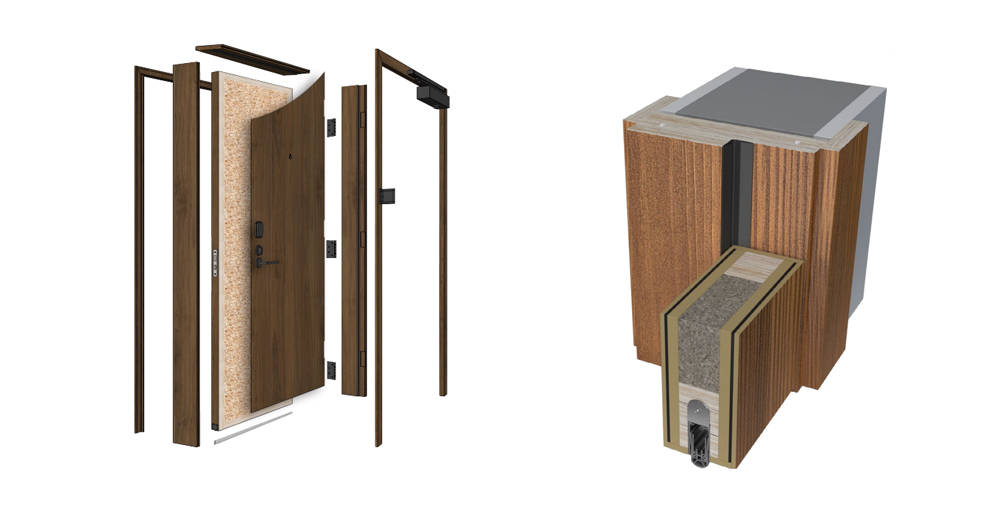
▲ Cross-section detail: Forest Brightacoustic door frame system — tested STC 42 as a complete assembly
Door Core Technology: Which Construction Delivers Superior Noise Reduction?
Not every wood door is built equal. The acoustic performance of an architectural door is primarily determined by its core construction, door slab mass, and perimeter sealing system. Below is an objective comparison of the four core types commonly specified in hospitality projects.
1. Hollow-Core (Not Recommended for Guest Areas)
Hollow-core doors use a cardboard honeycomb or corrugated fill between two thin wood veneers. They achieve STC ratings in the low 20s — barely better than an open doorway. While they remain common in budget construction due to low upfront cost, they create a negative acoustic experience that directly damages review scores and long-term RevPAR. Forest Bright does not manufacture hollow-core products for hotel applications.
2. Solid-Core Particleboard (Standard Performance)
A particleboard or MDF core dramatically increases slab mass, typically yielding STC 28–32 for the door slab alone. With a quality frame and perimeter seals, assemblies can reach STC 35 — sufficient for code compliance in most jurisdictions but below the threshold where guests perceive meaningfully quiet rooms. This is the entry-level offering for limited-service hotel corridors.
3. Multi-layer Core (High Performance — Forest Bright Signature)
Custom-developed acoustic core blocks low, mid, and high frequencies.
Triple-layer edge design paired with bottom auto-drop seal system maximizes airtightness.
Door, frame, and hardware engineered to millimeter-level precision.
Full door assemblies tested by certified third-party labs.
Fire-rated up to 60 minutes. Smoke-seal capability, Formaldehyde-free materials available.
Built to WDMA manufacturing specs, STC-rated for U.S. market compliance.
Guest Room Doors vs. Corridor Doors: Different Demands, Different Specs
A common specification mistake is treating the guest room entry door and the public corridor door as interchangeable. They serve related but distinct acoustic purposes — and their performance requirements, hardware loads, and finish durability demands differ considerably.
Guest Room Entry Doors
The primary function is to isolate the guest from corridor noise: housekeeping carts, elevator chimes, conversation, and HVAC ductwork penetrations. Best-practice specification for full-service properties:
- STC Target: 44–48 (full-service), 50+ (luxury)
- Core: Laminated composite or mineral wool acoustic fill
- Seals: Triple-perimeter compression seals + automatic door bottom
- Frame: Solid wood or steel-reinforced knock-down frame with acoustic gasket
- Closer: Surface-mounted or concealed with full-positive latching to maintain seal integrity
Corridor and Stairwell Doors
Corridor doors face a dual mandate: acoustic separation between floor zones and fire-rated egress compliance under NFPA 80 and IBC Chapter 7. Key specification considerations:
- Fire Rating: 20-minute, 45-minute, or 90-minute depending on corridor construction type
- UL Listing: Verify complete assembly — door, frame, hardware — carries the same listing
- Traffic Load: Specify Grade 1 or BHMA A156 mortise hardware for high-cycle durability
- Finish: Durable factory-applied polyurethane or catalyzed lacquer to resist housekeeping chemical contact
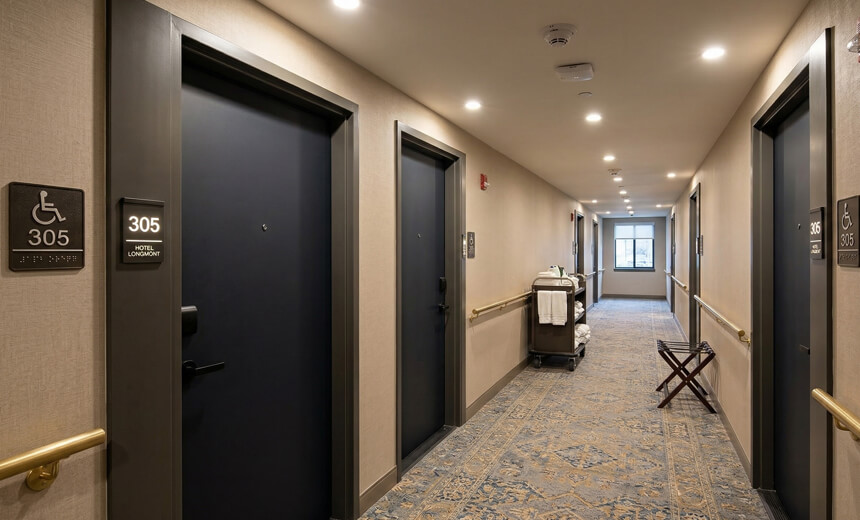
▲ Forest Bright fire-rated acoustic corridor door — STC 35 / 20-min. rated complete assembly
Connecting Room Doors: The Acoustic Weak Link Most Hotels Overlook
Connecting room door pairs consistently rank as the worst acoustic performers in a hotel’s door schedule, yet they are often specified as standard hollow-core pairs to minimize cost. The physics are unforgiving: two doors separated by only 2–4 inches of air space create a resonant cavity that can actually amplify certain frequencies relative to a single door. Operators running family-focused or resort properties — where connecting room occupancy rates are high — should consider this a priority upgrade.
Forest Bright’s connecting door system pairs two STC 35 solid-core slabs in a double-rabbet frame with independent perimeter seals on each leaf. As tested, the complete assembly achieves STC 35–42, closing the performance gap with non-connecting guest room doors and dramatically reducing inter-room complaint rates.
Specification Checklist: What to Ask Your Acoustic Door Supplier
When evaluating suppliers for a hotel door package, owners and specifiers should request documentation and clarification on the following points before committing to a purchase order:
Test Report Number: Request the ASTM E90 or ISO 140-3 lab test report — not just the marketing STC number. Verify the tested assembly matches what you are purchasing (slab + frame + seals).
Fire Rating Certificate: For corridor and stairwell applications, confirm the UL or Intertek listing number and ensure the hardware and glazing are included in the certification scope.
Seal System: Ask specifically about automatic door bottom type (mechanical, magnetic, or plunger-activated) and manufacturer. The seal is responsible for 60–70% of assembly performance.
Factory vs. Field Assembly: Factory-assembled, pre-hung door units dramatically outperform field-assembled units. Ask whether frames are machined and sealed in the factory or shipped loose.
Lead Times and Phasing: Acoustic door assemblies with custom veneer or laminate finishes typically require 8–14 weeks. Confirm production schedules align with MEP rough-in and flooring installation sequences.
Warranty Terms: Differentiate between slab warranty (typically 5–10 years against delamination) and acoustic performance warranty. Forest Bright provides a 5-year assembly acoustic performance guarantee.
Ready to Specify?
Get Forest Bright’s Hotel Door Specification Package
Includes STC test reports, fire rating certificates, full hardware schedules, finish samples, and lead-time worksheets — everything your design team needs to complete a door schedule in one package.
Request Specification Package →
No obligation · Respond within 1 business day · forestbright.com
